
CBSE Class 11 chemistry · ionic equilibrium · Physical chemistry
Source: CBSE Class 11 chemistry practical syllabus · use your school laboratory manual (NCERT Lab Manual where your school uses it).
Effect of common ion on pH (Class 11 chemistry practical)
You measure pH (indicator or paper) for a weak acid and for the same acid after adding a salt that supplies a common ion.
Acid concentration, salt mass, and volumes come from your laboratory manual.
Published practice page. Concentrations, masses, and numerical answers come from your school laboratory manual and your own readings — not invented here. Not yet reviewed by a named chemistry reviewer. Version 1.0.0, updated 2026-10-03.
Safety — read before you start
Safety warning. Practise here. Perform the real experiment only in your school lab, with your teacher present.
- Corrosive / irritant acids and salts.
- Eye protection mandatory.
Wear: Lab coat, Splash goggles, Gloves, as your teacher directs.
Follow your teacher’s disposal instructions. Do not pour leftovers down a household drain.
Loads only after you tap. Use the lab hands to pick up and use equipment (pointer hidden in the scene). Falls back to a flat diagram if WebGL is unavailable.
Aim
To study the change in pH of a weak acid solution on adding a salt containing a common ion, using the solutions and volumes in your laboratory manual.
Methods and quantities can differ between schools. Follow your teacher's instructions.
Apparatus and chemicals
| Item | Note |
|---|---|
| pH paper or universal indicator | Same method as your pH practical. |
| Graduated cylinders or pipettes | Use the concentration, mass, volume, and sample names printed in your school laboratory manual. This page does not invent numerical results for you. |
| Test tubes or beakers | Labelled. |
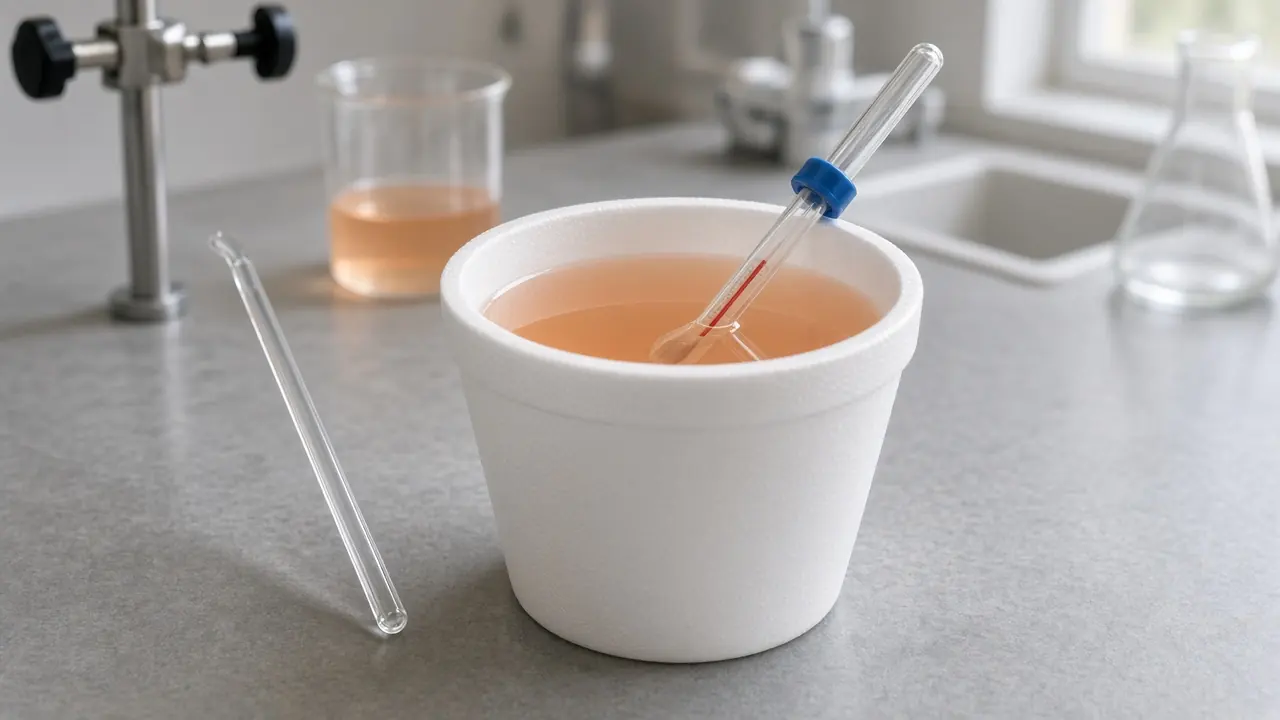
| Glass rod | Mix after adding salt. |
| Weak acid (e.g. acetic acid) (CH3COOH) | Use the concentration, mass, volume, and sample names printed in your school laboratory manual. This page does not invent numerical results for you. |
| Salt with common ion (e.g. sodium ethanoate) (CH3COONa) | Use the concentration, mass, volume, and sample names printed in your school laboratory manual. This page does not invent numerical results for you. |
Theory and reaction
Open
Weak acid partially dissociates: CH3COOH ⇌ H+ + CH3COO-.
Adding CH3COONa increases [CH3COO-]. By Le Chatelier’s principle, the equilibrium shifts left — [H+] falls and pH rises.
This is the common-ion effect on ionisation of a weak electrolyte.
Acetic acid equilibrium; common acetate ion suppresses ionisation.
Procedure
- Prepare the volume of weak acid solution your manual specifies. Record pH with paper or universal indicator.
- In a second vessel, prepare the same acid solution, then add the weighed salt your manual gives. Stir to dissolve.
- Record pH of the mixture using the same method as step 1.
- Note qualitatively whether pH increased, decreased, or stayed the same compared with acid alone.
- Write a one-line explanation using common ion and equilibrium shift language.
Observation table
Enter the readings from your school lab in the practical file below. This page does not fill them in for you.
Calculation
No numerical Ka required unless your manual asks for a calculation using its printed data.
Result
State pH estimates for both cases and whether the common ion increased pH as expected. Use your observed colours only.
Precautions
- Use the same indicator method for both readings.
- Dissolve salt completely before pH reading.
- Acetic acid vapour irritates — avoid breathing over open vessels.
Viva questions
Answer one question at a time. The full answers stay closed until you open them.
Question 1 of 4
Common-ion effect means…
Pick an answer first.
Show all questions and answers
Common-ion effect means…
Answer: Adding an ion already present in an equilibrium, shifting the position. Reason: Shared ion shifts equilibrium (Le Chatelier).
Adding CH₃COONa to CH₃COOH generally…
Answer: Decreases [H⁺] and raises pH. Reason: Extra acetate suppresses acid ionisation.
Le Chatelier’s principle predicts a system at equilibrium…
Answer: Shifts to partly counteract an applied stress. Reason: Counteracts imposed change.
A buffer-like mixture often contains…
Answer: A weak acid and its conjugate base (or weak base and conjugate acid). Reason: Weak acid + its salt is a classic buffer pair.
Common mistakes
- Different volumes of acid in the two tubes → unfair comparison.
- Reading pH before salt has dissolved.
- Claiming pH fell when common ion on weak acid should suppress H⁺ (for the usual acetate example).
- Inventing exact pH numbers not from your strips.
Frequently asked questions
- Can I do this at home?
- No. Use this page to practise the order of steps and viva. Do the real experiment only in your school laboratory, with your teacher present.
Your practical file
Name, school, and roll number are optional and are not sent anywhere.
The practical file opens on this device.
Review
Not yet reviewed by a named chemistry reviewer. Published for practice only — follow your teacher and laboratory manual for quantities and safety.
Related practicals
- Electron shells and quantum numbers
- Preparing a molar solution
- Periodic trends comparison
- Displacement redox reaction
- Enthalpy of neutralisation
- Detection of functional groups
- Tests for unsaturation
- Bending a glass tube
- Cutting a glass tube
- Drawing a glass jet
- Boring a cork
- Determination of melting point
- Determination of boiling point
- Purification by crystallisation
- Determination of pH of solutions
- Shift in chemical equilibrium
- Standard oxalic acid solution
- Titration of NaOH with oxalic acid
- Standard sodium carbonate solution
- Titration of HCl with sodium carbonate
- Qualitative salt analysis (one cation, one anion)
- Detection of N, S and halogen (Lassaigne)