
CBSE Class 11 chemistry · volumetric analysis · Volumetric analysis
Source: CBSE Class 11 chemistry practical syllabus · use your school laboratory manual (NCERT Lab Manual where your school uses it).
Standard oxalic acid solution (Class 11 chemistry practical)
Oxalic acid dihydrate is a primary standard for preparing an acid solution of known molarity in school work.
Target molarity, flask volume, and mass to weigh are in your laboratory manual.
Published practice page. Concentrations, masses, and numerical answers come from your school laboratory manual and your own readings — not invented here. Not yet reviewed by a named chemistry reviewer. Version 1.0.0, updated 2026-10-03.
Safety — read before you start
Safety warning. Practise here. Perform the real experiment only in your school lab, with your teacher present.
- Oxalic acid toxic if swallowed.
- Broken glass on volumetric flask.
Wear: Lab coat, Splash goggles, Gloves, as your teacher directs.
Follow your teacher’s disposal instructions. Do not pour leftovers down a household drain.
Loads only after you tap. Use the lab hands to pick up and use equipment (pointer hidden in the scene). Falls back to a flat diagram if WebGL is unavailable.
Aim
To prepare a standard solution of oxalic acid of the molarity specified in your laboratory manual using a volumetric flask.
Methods and quantities can differ between schools. Follow your teacher's instructions.
Apparatus and chemicals
| Item | Note |
|---|---|
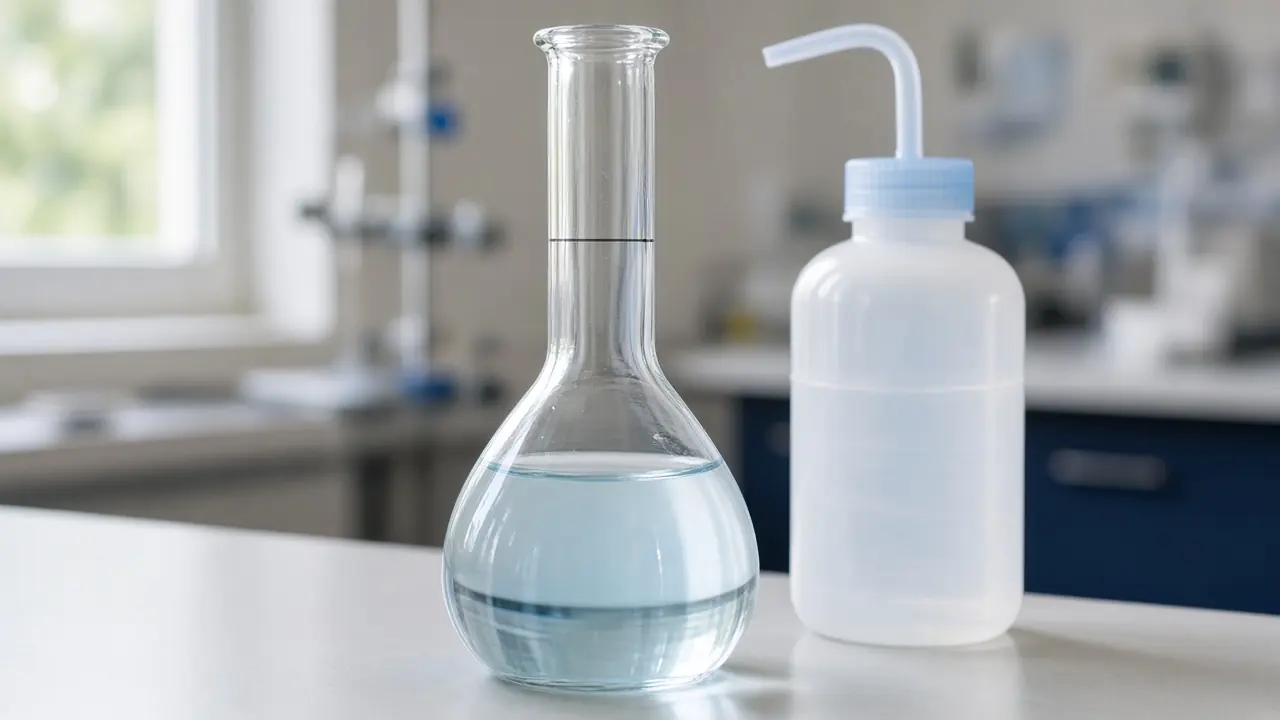
| Volumetric flask | Capacity from manual (often 250 mL). |
| Analytical balance | Weigh to precision your teacher requires. |
| Beaker, funnel, wash bottle | Quantitative transfer. |
| Watch glass | Weighing. |
| Oxalic acid dihydrate (H2C2O4·2H2O) | Use the concentration, mass, volume, and sample names printed in your school laboratory manual. This page does not invent numerical results for you. |
| Distilled water (H2O) | Solvent for make-up. |
Theory and reaction
Open
Oxalic acid dihydrate is a primary standard: stable, pure, and high molar mass for accurate weighing.
M = n/V with n = mass / molar mass. Basicity of oxalic acid is 2 for titration against NaOH (diprotic).
Dissolve fully before making up to the mark.
Oxalic acid neutralised by two moles NaOH per mole acid.
Procedure
- Calculate mass of H₂C₂O₄·2H₂O needed for the molarity and volume in your manual.
- Weigh on a watch glass. Transfer to a beaker and dissolve in distilled water.
- Quantitatively transfer to the volumetric flask; rinse beaker and rod into the flask.
- Make up to the mark with distilled water. Invert to mix.
- Label with name, molarity, date, and your initials.
Observation table
Enter the readings from your school lab in the practical file below. This page does not fill them in for you.
Calculation
mass = M × V(L) × molar mass of H₂C₂O₄·2H₂O. Use manual values; show your working with your weighed mass.
Result
Record the molarity you were asked to prepare and the mass you actually weighed.
Precautions
- Oxalic acid is toxic — do not ingest; wash after handling.
- Dissolve completely before final dilution.
- Meniscus on the mark at eye level.
Viva questions
Answer one question at a time. The full answers stay closed until you open them.
Question 1 of 4
Oxalic acid dihydrate is called a primary standard because…
Pick an answer first.
Show all questions and answers
Oxalic acid dihydrate is called a primary standard because…
Answer: It is available pure and stable for accurate weighing. Reason: Primary standards are pure and stable.
One mole of H₂C₂O₄ neutralises…
Answer: Two moles NaOH. Reason: Diprotic acid — two replaceable H⁺.
Why rinse the beaker into the volumetric flask?
Answer: To transfer all solute quantitatively. Reason: Quantitative transfer keeps the prepared molarity correct.
Molarity is defined as…
Answer: Moles of solute per litre of solution. Reason: M = n / V(solution in L).
Common mistakes
- Confusing anhydrous and dihydrate molar mass in calculation.
- Making up before solid has dissolved.
- Using tap water for a standard solution.
Frequently asked questions
- Can I do this at home?
- No. Use this page to practise the order of steps and viva. Do the real experiment only in your school laboratory, with your teacher present.
Your practical file
Name, school, and roll number are optional and are not sent anywhere.
The practical file opens on this device.
Review
Not yet reviewed by a named chemistry reviewer. Published for practice only — follow your teacher and laboratory manual for quantities and safety.
Related note
Open the theory noteRelated practicals
- Electron shells and quantum numbers
- Preparing a molar solution
- Periodic trends comparison
- Displacement redox reaction
- Enthalpy of neutralisation
- Detection of functional groups
- Tests for unsaturation
- Bending a glass tube
- Cutting a glass tube
- Drawing a glass jet
- Boring a cork
- Determination of melting point
- Determination of boiling point
- Purification by crystallisation
- Determination of pH of solutions
- Effect of common ion on pH
- Shift in chemical equilibrium
- Titration of NaOH with oxalic acid
- Standard sodium carbonate solution
- Titration of HCl with sodium carbonate
- Qualitative salt analysis (one cation, one anion)
- Detection of N, S and halogen (Lassaigne)