
Class 11 chemistry · basic laboratory techniques · Basic laboratory techniques
Source: CBSE Class 11 chemistry practical syllabus · use your school laboratory manual (NCERT Lab Manual where your school uses it).
Bending a glass tube (Class 11 chemistry practical)
You practise heating a short soda-glass tube until it softens, then forming a smooth bend without forcing cold glass.
The interactive lab only shows the order of stages. Angle and “good bend” judgement belong to your school lab with your teacher.
Published practice page. Concentrations, masses, and numerical answers come from your school laboratory manual and your own readings — not invented here. Not yet reviewed by a named chemistry reviewer. Version 1.0.0, updated 2026-10-03.
Safety — read before you start
Safety warning. Practise here. Perform the real experiment only in your school lab, with your teacher present.
- Open Bunsen flame — fire and burns.
- Hot glass looks cool and causes severe burns.
- Broken glass cuts; never force a stiff tube.
Wear: Lab coat, Splash goggles, Gloves, as your teacher directs.
Follow your teacher’s disposal instructions. Do not pour leftovers down a household drain.
Loads only after you tap. Use the lab hands to pick up and use equipment (pointer hidden in the scene). Falls back to a flat diagram if WebGL is unavailable.
Aim
To practise the basic technique of bending a soda-glass tube to a chosen angle using a Bunsen burner, following your laboratory manual.
Methods and quantities can differ between schools. Follow your teacher's instructions.
Apparatus and chemicals
| Item | Note |
|---|---|
| Soda-glass tube | Length is set by your manual (often about 20–25 cm). Softens in a Bunsen flame. |
| Bunsen burner | Use the flame setting your teacher shows for glass work. |
| Glazed tile | Heat-safe flat surface for cooling and keeping the bend coplanar. |
| Wire gauze / tongs (if required) | Only if your manual asks for them — hot glass burns. |
| Soda-lime (soda) glass tube (soda-lime glass) | Composition is approximate. Soft glass used for simple bends; it is not for strong thermal shock like borosilicate. |
Theory and reaction
Open
Soda-lime glass softens over a temperature range rather than melting at one sharp point. That is why a red-hot zone can be bent slowly.
Rotating the tube while heating spreads heat around the circumference so one side does not soften first and collapse.
A good bend keeps a fairly even bore. Inadequate heating or forcing cold glass flattens or kinks the inside of the curve. Local overheating can make the wall sag or puncture.
Common practice angles in school work are near 60°, 90°, and 120° — choose the angle your manual asks for.
No chemical equation. Softened glass is reshaped by gentle bending.
Picture guide
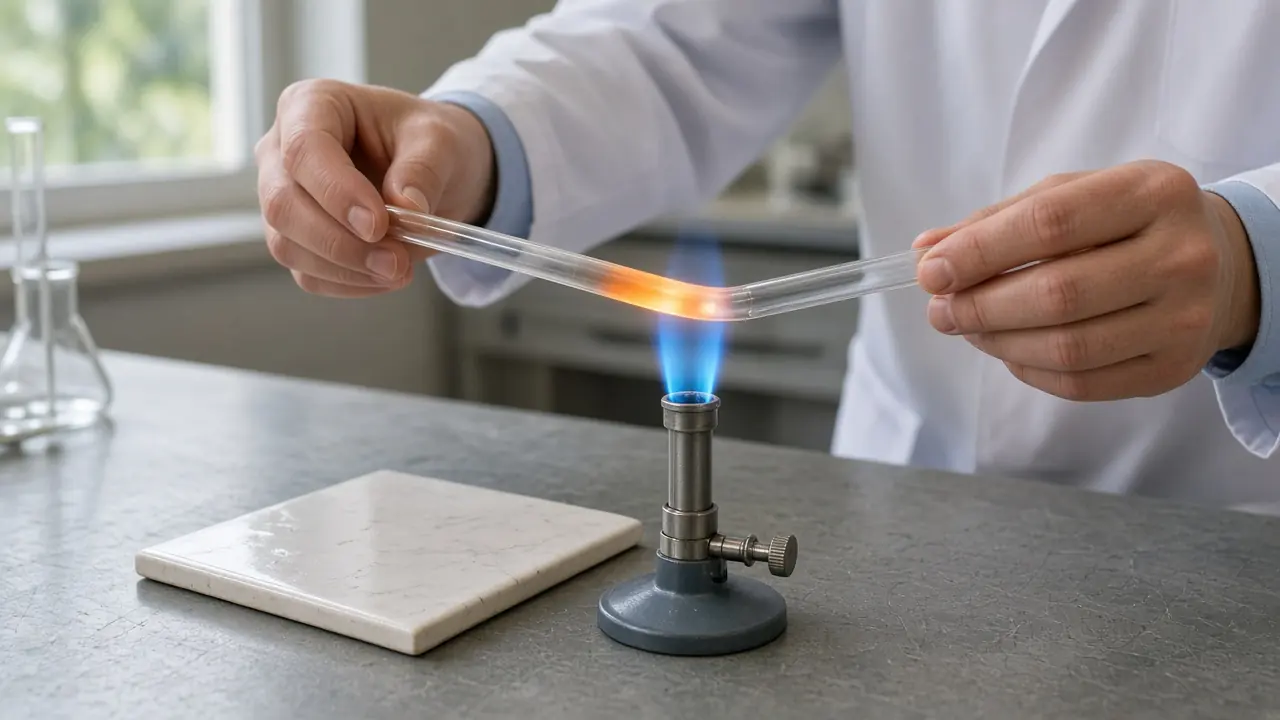
Procedure
- Hold the tube horizontally with both hands so the intended bend sits in the Bunsen flame.Safety: Keep your face away from the flame. Long hair and loose sleeves must be secured.
- Heat a length of several centimetres (your manual may say about 4–5 cm), not a pin-point spot.
- Rotate the tube steadily with thumbs and fingers so heating is even all around.
- When the heated zone softens (often described as red-hot), remove from the hottest part of the flame if your teacher directs, and apply only gentle pressure to form the angle you need.
- Lay the bent tube on a glazed tile so both arms sit flat (coplanar) while it cools. Do not quench in water unless your teacher has a different protocol.
Observation table
Enter the readings from your school lab in the practical file below. This page does not fill them in for you.
Calculation
No calculation. Record the angle your manual requires and a short note on bend quality.
Result
State the angle you formed and whether the bore looked even (good bend) under your teacher’s criteria.
Precautions
- Heat a band of tube, not a tiny spot.
- Rotate while heating so softening is uniform.
- Never force a bend on glass that is still stiff — cold force cracks the tube.
- Hot glass looks like cold glass. Place it only on the tile or holder your teacher allows.
- Keep face and clothing clear of the burner.
Viva questions
Answer one question at a time. The full answers stay closed until you open them.
Question 1 of 4
Why rotate the glass tube while heating?
Pick an answer first.
Show all questions and answers
Why rotate the glass tube while heating?
Answer: So heating and softening are even around the tube. Reason: Uneven heating softens one side first and spoils the bore.
Why bend only when the heated zone is soft (often called red-hot)?
Answer: Soft glass yields to gentle pressure; stiff glass cracks if forced. Reason: Gentle pressure on softened glass forms the curve; force on hard glass breaks it.
Where might a bent glass tube appear in school chemistry work?
Answer: In simple gas delivery / distillation-style setups your syllabus shows. Reason: Bent delivery tubes are common in gas and distillation apparatus diagrams.
Soda-lime glass for simple bends is best described as…
Answer: A soft silicate glass (silica with soda and lime) that softens in a Bunsen flame. Reason: School soda-glass tubing softens in a Bunsen flame; it is not treated like borosilicate heat-resistant ware.
Common mistakes
- Bending before the glass is soft enough → flattened or kinked inside curve.
- Overheating one point until the wall collapses.
- Cooling on an uneven surface so the bend is not coplanar.
- Copying a “perfect” diagram angle instead of the angle your manual asks for.
Frequently asked questions
- Can I do this at home?
- No. Use this page to practise the order of ideas and steps. Do the real experiment only in your school laboratory, with your teacher present.
- Does the interactive lab give me the correct school angle?
- No. The view only shows heating, softening, bending, and cooling stages. Your manual and teacher set the angle and what counts as a good bend.
Your practical file
Name, school, and roll number are optional and are not sent anywhere.
The practical file opens on this device.
Review
Not yet reviewed by a named chemistry reviewer. Published for practice only — follow your teacher and laboratory manual for quantities and safety.
Related practicals
- Electron shells and quantum numbers
- Preparing a molar solution
- Periodic trends comparison
- Displacement redox reaction
- Enthalpy of neutralisation
- Detection of functional groups
- Tests for unsaturation
- Cutting a glass tube
- Drawing a glass jet
- Boring a cork
- Determination of melting point
- Determination of boiling point
- Purification by crystallisation
- Determination of pH of solutions
- Effect of common ion on pH
- Shift in chemical equilibrium
- Standard oxalic acid solution
- Titration of NaOH with oxalic acid
- Standard sodium carbonate solution
- Titration of HCl with sodium carbonate
- Qualitative salt analysis (one cation, one anion)
- Detection of N, S and halogen (Lassaigne)