
CBSE Class 11 chemistry · chemical equilibrium · Physical chemistry
Source: CBSE Class 11 chemistry practical syllabus · use your school laboratory manual (NCERT Lab Manual where your school uses it).
Shift in chemical equilibrium (Class 11 chemistry practical)
Your school may use the blood-red thiocyanatoiron(III) system or the blue/pink cobalt chloride hydration equilibrium.
Reagent volumes and concentrations are in your laboratory manual.
Published practice page. Concentrations, masses, and numerical answers come from your school laboratory manual and your own readings — not invented here. Not yet reviewed by a named chemistry reviewer. Version 1.0.0, updated 2026-10-03.
Safety — read before you start
Safety warning. Practise here. Perform the real experiment only in your school lab, with your teacher present.
- Staining reagents.
- Acid fumes if HCl used.
- Do not ingest.
Wear: Lab coat, Splash goggles, Gloves, as your teacher directs.
Follow your teacher’s disposal instructions. Do not pour leftovers down a household drain.
Loads only after you tap. Use the lab hands to pick up and use equipment (pointer hidden in the scene). Falls back to a flat diagram if WebGL is unavailable.
Aim
To study the shift in chemical equilibrium on changing concentration or temperature for the equilibrium system demonstrated in your laboratory manual.
Methods and quantities can differ between schools. Follow your teacher's instructions.
Apparatus and chemicals
| Item | Note |
|---|---|
| Test tubes in a rack | Label each stress you apply. |
| Dropper pipettes | Separate for each reagent. |
| Beaker of hot water / ice (if manual includes temperature stress) | Teacher-supervised. |
| Glass rod | Mix after each addition. |
| Iron(III) chloride solution (FeCl3) | Use the concentration, mass, volume, and sample names printed in your school laboratory manual. This page does not invent numerical results for you. |
| Potassium thiocyanate solution (KSCN) | For Fe³⁺ + SCN⁻ ⇌ FeSCN²⁺ (blood red). |
| Cobalt(II) chloride (optional system) (CoCl2) | If manual uses Co²⁺ colour change with Cl⁻ or water. |
| Concentrated hydrochloric acid / water (HCl / H2O) | Only as manual directs for shifting Co or Fe equilibria. |
Theory and reaction
Open
Fe3+(aq) + SCN-(aq) ⇌ FeSCN2+(aq) gives an intense blood-red colour. Adding more Fe3+ or SCN- shifts right (more red); removing SCN- or diluting strategically shifts left (paler).
Co2+ in chloride media forms blue CoCl42-; adding water favours pink hydrated Co(H2O)62+ — a visual Le Chatelier demonstration.
Temperature change can shift the equilibrium if ΔH ≠ 0 for the reaction (manual may ask you to heat/cool one tube).
Fe3+ + SCN- equilibrium; cobalt chloride hydration/chloro complex equilibrium.
Picture guide
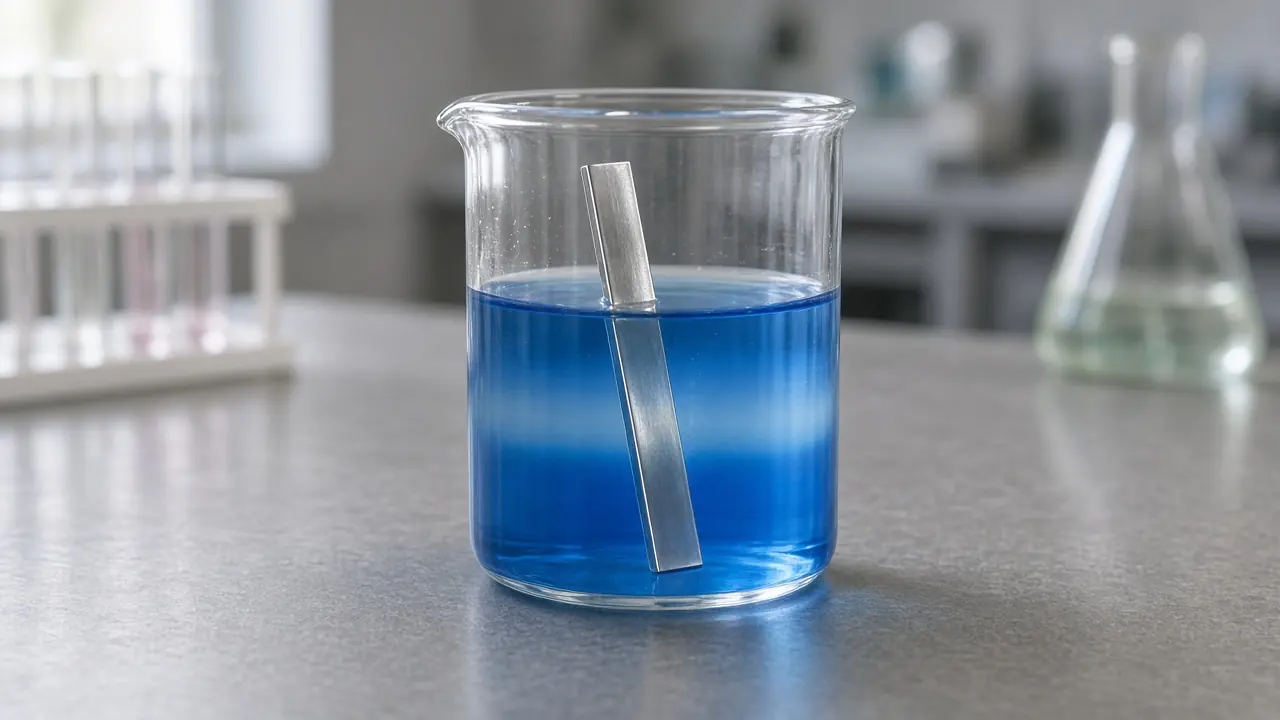
Procedure
- Prepare the equilibrium mixture your manual describes (e.g. FeCl₃ + KSCN to a clear blood-red reference tube).
- Apply concentration stress: add a drop of FeCl₃ or KSCN to a fresh portion; record colour change vs reference.
- Apply opposing stress: add water or reagent that removes an ion (as manual shows, e.g. slight dilution or precipitation step if given).
- If required, compare a tube in hot water vs ice water for the cobalt system or other temperature-sensitive setup.
- Write which direction the equilibrium shifted for each stress.
Observation table
Enter the readings from your school lab in the practical file below. This page does not fill them in for you.
Calculation
Qualitative only unless your manual includes a numerical exercise — use its data only.
Result
Summarise each stress and the colour change you actually saw, linked to equilibrium shift.
Precautions
- FeCl₃ and KSCN stain skin and clothing.
- Acids only as directed; conc. HCl fumes — fume cupboard if your lab uses one.
- Do not mix unknown leftovers.
Viva questions
Answer one question at a time. The full answers stay closed until you open them.
Question 1 of 4
Blood-red colour with Fe³⁺ and SCN⁻ is mainly due to…
Pick an answer first.
Show all questions and answers
Blood-red colour with Fe³⁺ and SCN⁻ is mainly due to…
Answer: Formation of FeSCN²⁺ complex. Reason: Thiocyanatoiron(III) complex is intensely coloured.
Adding more SCN⁻ to Fe³⁺ + SCN⁻ equilibrium generally…
Answer: Shifts towards FeSCN²⁺ (more red). Reason: Increased product-side ion favours forward shift.
Le Chatelier: increasing a reactant concentration shifts equilibrium…
Answer: Towards products. Reason: System partly consumes added reactant.
Anhydrous CoCl₂ paper is useful because…
Answer: Hydration colour change shows water presence. Reason: Co²⁺ colour shifts with hydration (related demo).
Common mistakes
- Calling a pale tube “no equilibrium”.
- Adding too much reagent so colour is too intense to compare.
- Ignoring temperature when comparing tubes (hot vs cold).
- Writing a shift direction opposite to Le Chatelier for the stress you applied.
Frequently asked questions
- Can I do this at home?
- No. Use this page to practise the order of steps and viva. Do the real experiment only in your school laboratory, with your teacher present.
Your practical file
Name, school, and roll number are optional and are not sent anywhere.
The practical file opens on this device.
Review
Not yet reviewed by a named chemistry reviewer. Published for practice only — follow your teacher and laboratory manual for quantities and safety.
Related practicals
- Electron shells and quantum numbers
- Preparing a molar solution
- Periodic trends comparison
- Displacement redox reaction
- Enthalpy of neutralisation
- Detection of functional groups
- Tests for unsaturation
- Bending a glass tube
- Cutting a glass tube
- Drawing a glass jet
- Boring a cork
- Determination of melting point
- Determination of boiling point
- Purification by crystallisation
- Determination of pH of solutions
- Effect of common ion on pH
- Standard oxalic acid solution
- Titration of NaOH with oxalic acid
- Standard sodium carbonate solution
- Titration of HCl with sodium carbonate
- Qualitative salt analysis (one cation, one anion)
- Detection of N, S and halogen (Lassaigne)