
Class 11 chemistry · linked to Redox reactions · Physical chemistry experiments
Source: CBSE Class 11 chemistry practical syllabus · use your school laboratory manual (NCERT Lab Manual where your school uses it).
Displacement redox reaction (Class 11 chemistry practical)
You observe a metal strip in a salt solution and decide which species is oxidised and which is reduced.
Which metals and what concentrations you use come from your manual — not invented here.
Published practice page. Concentrations, masses, and numerical answers come from your school laboratory manual and your own readings — not invented here. Not yet reviewed by a named chemistry reviewer. Version 1.0.0, updated 2026-10-03.
Safety — read before you start
Safety warning. Practise here. Perform the real experiment only in your school lab, with your teacher present.
- Metal salt solutions can be toxic or irritant.
- Some metals react vigorously — only use the pair and amount your teacher assigns.
Wear: Lab coat, Splash goggles, Gloves, as your teacher directs.
Follow your teacher’s disposal instructions. Do not pour leftovers down a household drain.
Loads only after you tap. Use the lab hands to pick up and use equipment (pointer hidden in the scene). Falls back to a flat diagram if WebGL is unavailable.
Aim
To carry out a displacement reaction between a metal and a salt solution specified in your laboratory manual, and to identify the oxidising and reducing agents.
Methods and quantities can differ between schools. Follow your teacher's instructions.
Apparatus and chemicals
| Item | Note |
|---|---|
| Test tubes / beaker | Clean and dry as your teacher directs. |
| Metal strip or granules | As named in the manual. |
| Forceps and emery paper | Clean the metal surface if required. |
| Salt solution (manual) (salt solution) | Identity and concentration not printed here until checked. |
| Metal sample (manual) (metal) | Do not substitute a different metal without your teacher. |
Theory and reaction
Open
Oxidation = loss of electrons; reduction = gain of electrons.
The metal that dissolves is oxidised (reducing agent). The ion that plates out or is consumed in solution is reduced (oxidising agent).
Example pattern only: Zn + Cu2+ → Zn2+ + Cu. Your manual’s pair may differ.
Metal M displaces ion of N from solution when M is more reactive.
Picture guide
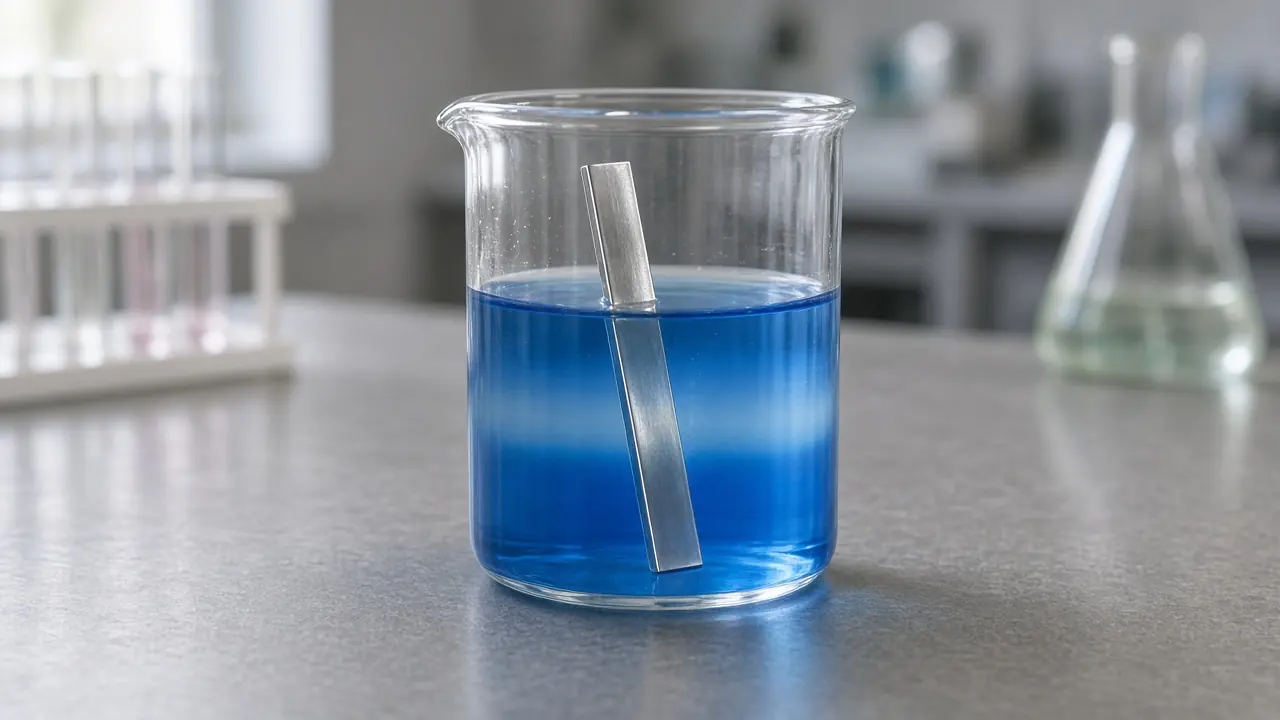
Procedure
- Clean the metal sample if the manual says to.
- Pour the assigned volume of salt solution into a clean tube or beaker.
- Add the metal. Note colour of solution and surface of the metal at the start.
- Wait the time your manual states. Record changes (deposit, colour fade, gas, heat).
- Write half-reactions and the net ionic equation using only the pair you actually used.
Observation table
Enter the readings from your school lab in the practical file below. This page does not fill them in for you.
Calculation
No titre unless your manual adds a quantitative follow-up. Identify ox. nos. before and after.
Result
State the displacement you observed and name the oxidising and reducing agents.
Precautions
- Do not taste solutions. Do not pipette by mouth.
- Dispose of metal ions as your teacher instructs — many are environmental hazards.
Viva questions
Answer one question at a time. The full answers stay closed until you open them.
Question 1 of 3
In Zn + Cu²⁺ → Zn²⁺ + Cu, what is oxidised?
Pick an answer first.
Show all questions and answers
In Zn + Cu²⁺ → Zn²⁺ + Cu, what is oxidised?
Answer: Zn. Reason: Zinc loses electrons.
The oxidising agent is the species that…
Answer: Is reduced. Reason: It gains electrons / is reduced.
Oxidation number of an element in free form is…
Answer: 0. Reason: Free elements are 0.
Common mistakes
- Calling the ion that gains electrons the reducing agent.
- Using a metal/solution pair not in the reactivity order your syllabus teaches.
- Inventing a balanced equation for chemicals you did not use.
Frequently asked questions
- Can I do this at home?
- No. Use this page to practise the order of ideas and steps. Do the real experiment only in your school laboratory, with your teacher present.
Your practical file
Name, school, and roll number are optional and are not sent anywhere.
The practical file opens on this device.
Review
Not yet reviewed by a named chemistry reviewer. Published for practice only — follow your teacher and laboratory manual for quantities and safety.
Related notes
Related practicals
- Electron shells and quantum numbers
- Preparing a molar solution
- Periodic trends comparison
- Enthalpy of neutralisation
- Detection of functional groups
- Tests for unsaturation
- Bending a glass tube
- Cutting a glass tube
- Drawing a glass jet
- Boring a cork
- Determination of melting point
- Determination of boiling point
- Purification by crystallisation
- Determination of pH of solutions
- Effect of common ion on pH
- Shift in chemical equilibrium
- Standard oxalic acid solution
- Titration of NaOH with oxalic acid
- Standard sodium carbonate solution
- Titration of HCl with sodium carbonate
- Qualitative salt analysis (one cation, one anion)
- Detection of N, S and halogen (Lassaigne)