
CBSE Class 11 chemistry · volumetric analysis · Volumetric analysis
Source: CBSE Class 11 chemistry practical syllabus · use your school laboratory manual (NCERT Lab Manual where your school uses it).
Titration of HCl with sodium carbonate (Class 11 chemistry practical)
You titrate the given HCl against pipetted standard Na₂CO₃ (or the reverse if your manual says so).
Concentrations and volumes are manual-driven.
Published practice page. Concentrations, masses, and numerical answers come from your school laboratory manual and your own readings — not invented here. Not yet reviewed by a named chemistry reviewer. Version 1.0.0, updated 2026-10-03.
Safety — read before you start
Safety warning. Practise here. Perform the real experiment only in your school lab, with your teacher present.
- HCl is corrosive and produces irritating fumes.
- Wear goggles and gloves; wipe acid spills as your teacher directs.
Wear: Lab coat, Splash goggles, Gloves, as your teacher directs.
Follow your teacher’s disposal instructions. Do not pour leftovers down a household drain.
Loads only after you tap. Use the lab hands to pick up and use equipment (pointer hidden in the scene). Falls back to a flat diagram if WebGL is unavailable.
Aim
To determine the molarity (strength) of the given hydrochloric acid by titrating against the standard sodium carbonate solution from your laboratory manual.
Methods and quantities can differ between schools. Follow your teacher's instructions.
Apparatus and chemicals
| Item | Note |
|---|---|
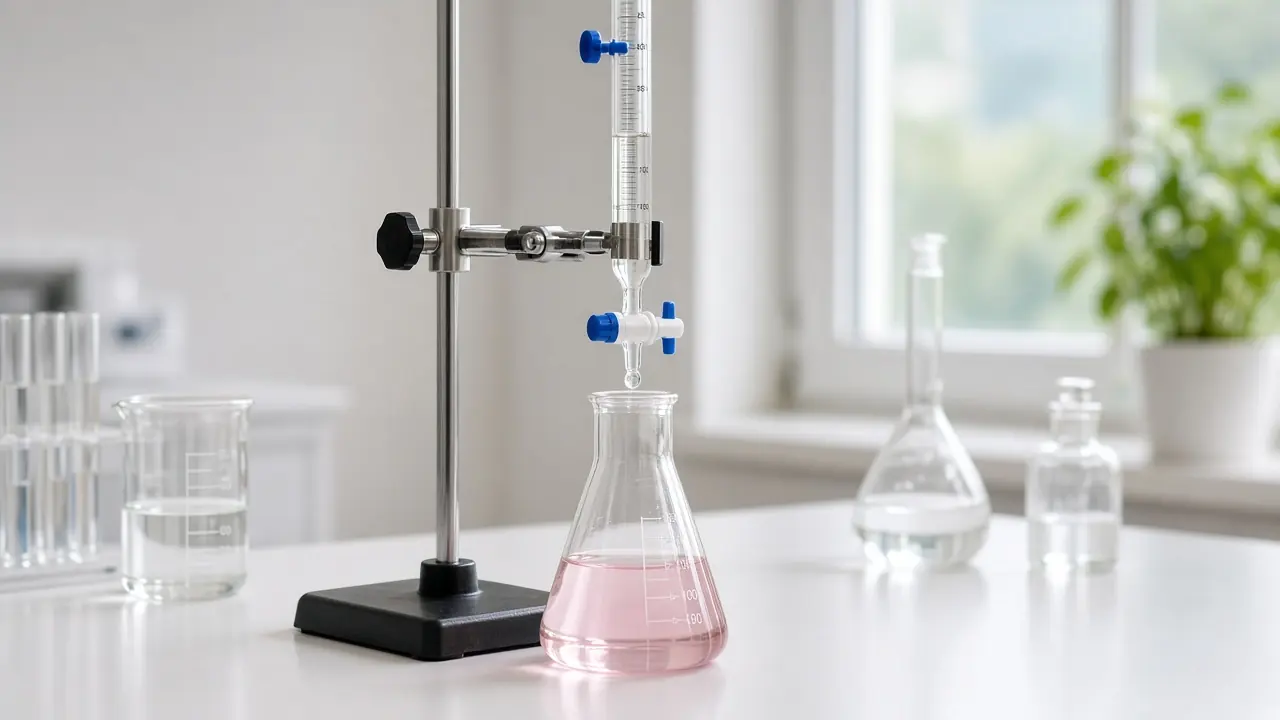
| Burette and stand | HCl or Na₂CO₃ placement as manual. |
| Pipette | Rinse with solution you pipette. |
| Conical flask | Distilled water rinse only. |
| Methyl orange indicator | Yellow to pink/red end point in acid medium. |
| White tile | End-point visibility. |
| Hydrochloric acid (unknown) (HCl) | Use the concentration, mass, volume, and sample names printed in your school laboratory manual. This page does not invent numerical results for you. |
| Standard Na₂CO₃ (Na2CO3) | Use the concentration, mass, volume, and sample names printed in your school laboratory manual. This page does not invent numerical results for you. |
| Methyl orange (methyl orange) | Few drops. |
Theory and reaction
Open
Na2CO3 + 2HCl → 2NaCl + H2O + CO2. Methyl orange end point marks completion to acidic products.
Effervescence may be seen — swirl gently.
Calculate HCl molarity from pipette volume of carbonate, known carbonate molarity, and titre volume of acid.
Carbonate neutralised by two equivalents HCl at methyl orange end point.
Procedure
- Fill burette with HCl after rinse. Record initial reading.
- Pipette Na₂CO₃ into flask. Add methyl orange.
- Titrate until colour changes from yellow to the pink/orange end point your manual describes.
- Repeat for concordant titres.
- Calculate HCl molarity using 2:1 HCl:Na₂CO₃ mole ratio.
Observation table
Enter the readings from your school lab in the practical file below. This page does not fill them in for you.
Calculation
n(HCl) = 2 × n(Na₂CO₃) for pipetted carbonate. M(HCl) = moles / titre volume in L.
Result
State HCl molarity from your concordant readings.
Precautions
- HCl fumes — ventilation.
- CO₂ bubbles: swirl, do not shake violently.
- Methyl orange choice matches strong acid–weak base salt titration curve region.
Viva questions
Answer one question at a time. The full answers stay closed until you open them.
Question 1 of 4
Methyl orange is preferred here because…
Pick an answer first.
Show all questions and answers
Methyl orange is preferred here because…
Answer: End point is in acidic pH range matching complete reaction with carbonate. Reason: Carbonate titration to CO₂ needs acidic end point.
Gas evolved during titration is…
Answer: CO₂. Reason: Carbonate + acid produces carbon dioxide.
If you pipette Na₂CO₃, the burette typically holds…
Answer: HCl of unknown strength. Reason: Unknown acid titrated against known carbonate.
Rinsing the conical flask with distilled water before titration…
Answer: Does not change moles already delivered by pipette. Reason: Pipette fixes moles; extra water dilutes but does not change mole count.
Common mistakes
- Using phenolphthalein when manual specifies methyl orange for complete reaction.
- 1:1 mole ratio error.
- Over-titrating past sharp end point.
Frequently asked questions
- Can I do this at home?
- No. Use this page to practise the order of steps and viva. Do the real experiment only in your school laboratory, with your teacher present.
Your practical file
Name, school, and roll number are optional and are not sent anywhere.
The practical file opens on this device.
Review
Not yet reviewed by a named chemistry reviewer. Published for practice only — follow your teacher and laboratory manual for quantities and safety.
Related practicals
- Electron shells and quantum numbers
- Preparing a molar solution
- Periodic trends comparison
- Displacement redox reaction
- Enthalpy of neutralisation
- Detection of functional groups
- Tests for unsaturation
- Bending a glass tube
- Cutting a glass tube
- Drawing a glass jet
- Boring a cork
- Determination of melting point
- Determination of boiling point
- Purification by crystallisation
- Determination of pH of solutions
- Effect of common ion on pH
- Shift in chemical equilibrium
- Standard oxalic acid solution
- Titration of NaOH with oxalic acid
- Standard sodium carbonate solution
- Qualitative salt analysis (one cation, one anion)
- Detection of N, S and halogen (Lassaigne)