
Chemistry
Pick your class, then the practical
Class 11 practice labs and Class 12 school practicals. Use your laboratory manual for concentrations and masses.
Physical chemistry experiments
Lyophilic and lyophobic sols
Prepare and compare lyophilic sols (e.g. starch or gum) with lyophobic sols (e.g. ferric hydroxide), and note how they differ in stability and dialysis behaviour.
Open
Dialysis of a sol
Purify a prepared sol (often ferric hydroxide or starch) using a parchment or cellophane bag in distilled water and observe diffusion of electrolytes.
Open
Emulsions and emulsifying agents
Shake oil and water to form an emulsion, then show how soap or gum stabilises the dispersion and how breaking agents act.
Open
Rate of reaction between sodium thiosulphate and hydrochloric acid
Study how concentration or temperature affects the time for a fixed amount of sulphur to turbid a marked cross beneath the flask.
Open
Clock reaction (iodine clock)
Mix iodate, sulphite, and starch (or iodide–peroxide variant) and record the sudden blue-black appearance after a predictable induction time.
Open
Enthalpy of dissolution
Dissolve a salt such as copper(II) sulphate or potassium nitrate in water in a calorimeter and calculate ΔH from temperature change.
Open
Enthalpy of neutralisation (Class 12)
Determine ΔH for strong acid–strong base neutralisation in a calorimeter, with emphasis on concordant temperature rises and heat capacity of the calorimeter.
Open
Concentration cell: cell potential and Nernst equation
Set up a Daniell-type concentration cell (Zn | Zn²⁺ || Cu²⁺ | Cu) with different ion concentrations and relate emf to the Nernst equation using your readings.
Open
Organic qualitative analysis
Paper chromatography of leaf and flower pigments
Separate pigments on chromatography paper, mark solvent front, and calculate Rf values from your measured distances.
Open
Detection of functional groups (Class 12)
Systematic tests for unsaturation, alcohol, phenol, aldehyde, ketone, carboxylic acid, and amine/amino groups on assigned organic samples.
Open
Tests for carbohydrates, fats, and proteins in foodstuffs
Apply Benedict’s, iodine, grease-spot, and biuret (or xanthoproteic) tests to common food samples and record which macronutrients are present.
Open
Volumetric analysis
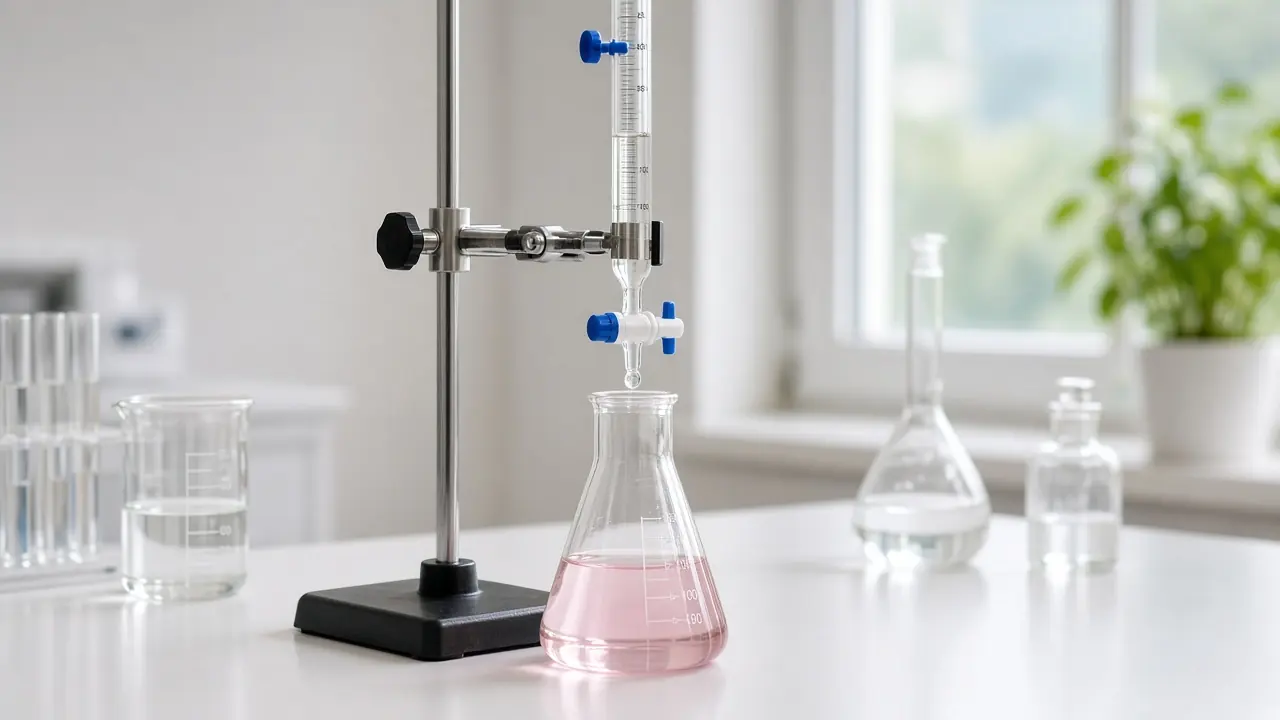
Titration of KMnO4 with oxalic acid
Practise standardising potassium permanganate against oxalic acid, including the warm-solution technique and spotting the permanent pink end point. Includes viva questions and a place to record your own concordant readings.
Open
Titration of KMnO4 with Mohr’s salt
Titrate permanganate against ferrous ammonium sulphate in dilute sulphuric acid. Learn why this titration needs no extra indicator and why the acid you choose matters.
Open
Preparation of compounds
Preparation of Mohr’s salt
Prepare crystals of ferrous ammonium sulphate from ferrous sulphate and ammonium sulphate. Covers dissolving, acidifying, concentrating and crystallising, and what the viva usually asks about double salts.
Open
Preparation of potash alum
Make potassium aluminium sulphate crystals and learn how to get well-formed crystals instead of a powder.
Open
Preparation of potassium trioxalatoferrate(III)
Prepare green crystals of potassium trioxalatoferrate(III) from ferric chloride, oxalic acid, and potassium oxalate, then note colour and composition tests.
Open
Preparation of acetanilide
Acetylate aniline with acetic anhydride to prepare acetanilide crystals — classic Class 12 organic preparation with recrystallisation.
Open
Salt analysis
Salt analysis: anions
Work through dry and wet tests to identify the anion in an inorganic salt, with a clear record of tests, observations and inferences.
Open
Salt analysis: cations (Class 12)
Identify cations by group analysis — NH₄⁺, Pb²⁺, Cu²⁺, As³⁺, Fe³⁺, Al³⁺, Co²⁺, Ni²⁺, Mn²⁺, Zn²⁺, Ba²⁺, Ca²⁺, Sr²⁺, Mg²⁺ — using manual group reagents.
Open