
CBSE Class 12 chemistry practical, Thermochemistry · Physical chemistry experiments
Source: CBSE Class 12 chemistry practical syllabus · use your school laboratory manual (NCERT Lab Manual where your school uses it).
Enthalpy of dissolution (Class 12 chemistry practical)
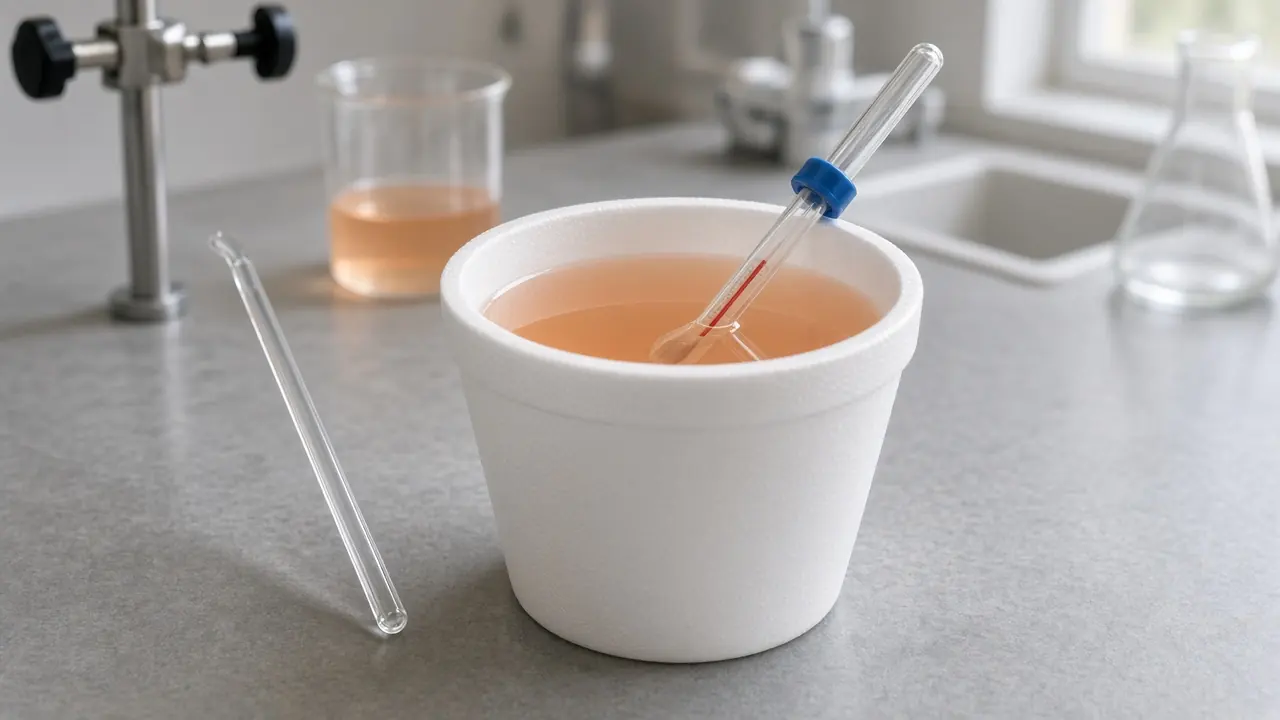
You dissolve a weighed salt in water in an insulated cup and follow the temperature.
Mass of salt, water volume, and specific heat capacity come from your manual — ΔH comes from your ΔT.
Published practice page. Concentrations, masses, and numerical answers come from your school laboratory manual and your own readings — not invented here. Not yet reviewed by a named chemistry reviewer. Version 1.0.0, updated 2026-10-03.
Safety — read before you start
Safety warning. Practise here. Perform the real experiment only in your school lab, with your teacher present.
- Copper(II) salts are harmful if swallowed and irritate skin and eyes.
- Avoid skin contact with salt solutions; wash spills with water as your teacher directs.
Wear: Lab coat, Splash goggles, Gloves, as your teacher directs.
Follow your teacher’s disposal instructions. Do not pour leftovers down a household drain.
Loads only after you tap. Use the lab hands to pick up and use equipment (pointer hidden in the scene). Falls back to a flat diagram if WebGL is unavailable.
Aim
To determine the enthalpy of dissolution of the salt assigned in your laboratory manual (e.g. copper(II) sulphate pentahydrate or potassium nitrate) using a simple calorimeter.
Methods and quantities can differ between schools. Follow your teacher's instructions.
Apparatus and chemicals
| Item | Note |
|---|---|
| Polystyrene cup calorimeter with lid | Thermometer hole in lid. |
| Thermometer (0.1 °C or better if available) | Read at eye level. |
| Balance | Weigh salt to manual precision. |
| Measuring cylinder | Water volume as stated. |
| Glass rod | Stir until salt dissolves. |
| Copper(II) sulphate pentahydrate or potassium nitrate (CuSO4·5H2O or KNO3) | Use the concentration, mass, and volume values printed in your school laboratory manual. This page does not invent a numerical result for you. |
| Distilled water (H2O) | Volume from manual. |
Theory and reaction
Open
Dissolution is heat exchange between crystal lattice breaking and ion hydration.
CuSO4·5H2O dissolution is often endothermic overall (solution cools); KNO3 dissolution is commonly endothermic in school manuals — trust your thermometer sign.
q = (m_water c_water + C_cal) ΔT; ΔH = q / moles of salt dissolved at constant pressure.
Solid copper sulphate dissolves to ions; enthalpy change comes from your calorimeter readings.
Procedure
- Weigh the mass of salt your manual specifies. Measure water volume into the calorimeter.
- Record initial temperature of water with stirring.
- Add salt quickly, lid on, stir until dissolved. Record the stable final temperature.Safety: Copper salts are harmful — do not ingest. Avoid skin contact.
- Compute ΔT and heat absorbed or evolved using the formula in your manual.
- Convert to ΔH per mole of salt with correct sign (endothermic +, exothermic − as your teacher defines).
Observation table
Enter the readings from your school lab in the practical file below. This page does not fill them in for you.
Calculation
Use q = m c ΔT (include calorimeter constant if given). Moles = mass / molar mass. ΔH = q / n. No sample numbers on this page.
Result
Report ΔH of dissolution in kJ mol⁻¹ with sign, from your temperatures and weighed mass.
Precautions
- Ensure complete dissolution before final temperature reading.
- Account for heat loss — lid on, gentle stir.
- Use anhydrous calculation basis if manual uses CuSO₄·5H₂O — check which formula they want.
Viva questions
Answer one question at a time. The full answers stay closed until you open them.
Question 1 of 4
If the solution temperature falls during dissolution, the process is…
Pick an answer first.
Show all questions and answers
If the solution temperature falls during dissolution, the process is…
Answer: Endothermic. Reason: Heat taken from surroundings lowers temperature.
Lattice enthalpy is…
Answer: Energy to separate ions in gas phase from solid. Reason: Lattice enthalpy is defined for ionic solids going to gaseous ions.
Hydration enthalpy is generally…
Answer: Negative (exothermic) for ion–water binding. Reason: Ion–dipole interactions release energy when ions solvate.
Why use an insulated calorimeter?
Answer: To reduce heat exchange with surroundings. Reason: Minimise q_loss so measured ΔT reflects the dissolution.
Common mistakes
- Using mass of anhydrous CuSO₄ while weighing the pentahydrate without conversion.
- Wrong sign for endothermic cooling.
- Copying a textbook ΔH instead of calculating from your ΔT.
Frequently asked questions
- Can I do this at home?
- No. Use this page to practise the order of steps and viva. Do the real experiment only in your school laboratory, with your teacher present.
Your practical file
Name, school, and roll number are optional and are not sent anywhere.
The practical file opens on this device.
Review
Not yet reviewed by a named chemistry reviewer. Published for practice only — follow your teacher and laboratory manual for quantities and safety.
Related practicals
- Titration of KMnO4 with oxalic acid
- Titration of KMnO4 with Mohr’s salt
- Preparation of Mohr’s salt
- Preparation of potash alum
- Salt analysis: anions
- Lyophilic and lyophobic sols
- Dialysis of a sol
- Emulsions and emulsifying agents
- Rate of reaction between sodium thiosulphate and hydrochloric acid
- Clock reaction (iodine clock)
- Enthalpy of neutralisation (Class 12)
- Concentration cell: cell potential and Nernst equation
- Paper chromatography of leaf and flower pigments
- Preparation of potassium trioxalatoferrate(III)
- Preparation of acetanilide
- Detection of functional groups (Class 12)
- Tests for carbohydrates, fats, and proteins in foodstuffs
- Salt analysis: cations (Class 12)