
CBSE Class 12 chemistry practical · Volumetric analysis
Source: CBSE Class 12 chemistry practical syllabus · use your school laboratory manual (NCERT Lab Manual where your school uses it).
Titration of KMnO4 with oxalic acid (Class 12 chemistry practical)
You titrate potassium permanganate against oxalic acid and record your own burette readings.
You practise the order of steps and the viva questions. The numerical result comes from your readings, not from this page.
Published practice page. Concentrations, masses, and numerical answers come from your school laboratory manual and your own readings — not invented here. Not yet reviewed by a named chemistry reviewer. Version 1.0.0, updated 2026-10-03.
Safety — read before you start
Safety warning. Practise here. Perform the real experiment only in your school lab, with your teacher present.
- Dilute sulphuric acid is corrosive.
- Oxalic acid is harmful if swallowed and can irritate skin and eyes.
- Potassium permanganate is an oxidiser and stains skin and cloth.
Wear: Lab coat, Splash goggles, Gloves, as your teacher directs.
Follow your teacher’s disposal instructions. Do not pour leftovers down a household drain.
Loads only after you tap. Use the lab hands to pick up and use equipment (pointer hidden in the scene). Falls back to a flat diagram if WebGL is unavailable.
Aim
To find the strength of a potassium permanganate solution by titrating it against a standard oxalic acid solution, using the volumes and concentration given in your laboratory manual.
Methods and quantities can differ between schools. Follow your teacher's instructions.
Apparatus and chemicals
| Item | Note |
|---|---|
| Burette and stand | Used for the permanganate solution. |
| Pipette and filler | Use a bulb or filler. Do not pipette by mouth. |
| Conical flask | Rinse with distilled water only. |
| Funnel | Remove it before you read the burette. |
| White tile | Makes the pale pink end point easier to see. |
| Wash bottle | Distilled water, for rinsing the flask walls. |
| Potassium permanganate solution (KMnO4) | Goes in the burette. Use the concentration, mass, and volume values printed in your school laboratory manual. This page does not invent a numerical result for you. |
| Standard oxalic acid solution (H2C2O4·2H2O) | Measured with the pipette. Use the concentration, mass, and volume values printed in your school laboratory manual. This page does not invent a numerical result for you. |
| Dilute sulphuric acid (H2SO4) | Add the volume your manual specifies. Do not replace it with hydrochloric acid or nitric acid. |
Theory and reaction
Open
In acidic solution, permanganate ions oxidise oxalate ions. The purple permanganate is reduced to manganese(II), which is almost colourless, so the colour fades while oxalic acid is still present.
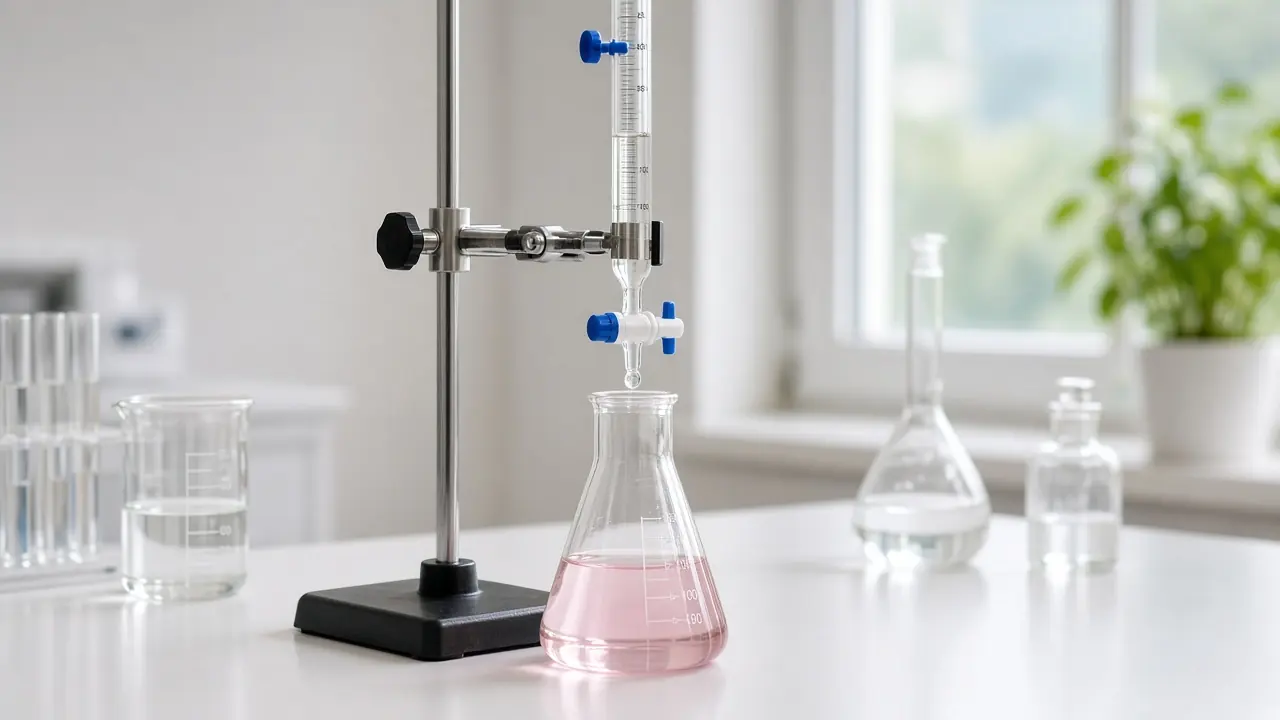
The end point is the first pale pink that stays. That pink is a slight excess of permanganate. No separate indicator is added.
The balanced equation fixes the mole ratio: 2 moles of permanganate react with 5 moles of oxalic acid.
2 MnO4- + 5 C2O4 2- + 16 H+ gives 2 Mn2+ + 10 CO2 + 8 H2O
Procedure
- Rinse the burette with a little potassium permanganate solution, then fill it. Let out any air bubble in the tip. Read the initial level.
- Rinse the pipette with oxalic acid solution. Transfer the volume your manual specifies into the conical flask.
- Add the dilute sulphuric acid your manual specifies.Safety: Dilute sulphuric acid is corrosive. Add it as your teacher shows you.
- Warm the flask the way your laboratory manual describes.
- Put the flask on a white tile and run in permanganate while you swirl. The purple colour disappears while oxalic acid remains.
- Stop at the first pale pink that does not fade straight away. Read the burette again.
- Repeat until your readings agree as closely as your teacher expects.
Observation table
Enter the readings from your school lab in the practical file below. This page does not fill them in for you.
Calculation
Use the 2:5 mole ratio from the balanced equation, the pipette volume, the oxalic acid concentration from your manual, and the concordant burette volume. Do not copy a molarity from another source onto this sheet.
Result
Write the strength you calculate from your own concordant readings, with the unit mol L⁻¹ (mol per litre).
Precautions
- Read the burette with your eye level with the surface you are reading.
- Rinse the burette with permanganate, and the pipette with oxalic acid.
- Rinse the conical flask with distilled water only. Rinsing it with oxalic acid adds an unknown extra amount.
- Take the funnel out before you take a reading.
- Swirl the flask the whole time.
- A deep pink means you have gone past the end point. A pink that vanishes at once is not the end point yet.
Viva questions
Answer one question at a time. The full answers stay closed until you open them.
Question 1 of 4
Why do you rinse the burette with potassium permanganate solution before you fill it?
Pick an answer first.
Show all questions and answers
Why do you rinse the burette with potassium permanganate solution before you fill it?
Answer: So water left inside does not dilute the permanganate. Reason: A film of water left in the burette mixes with the first portion of permanganate and changes its concentration.
Why may the conical flask be rinsed with distilled water, but not with oxalic acid?
Answer: Water does not change how much oxalic acid the pipette already delivered. Reason: The pipette has already measured a fixed amount. Extra water in the flask does not change that amount. Extra oxalic acid would.
What do you look for at the end point?
Answer: A lasting pale pink. Reason: Permanganate is purple and acts as its own indicator. The first pale pink that stays means a slight excess of permanganate.
Which acid is used in this titration?
Answer: Dilute sulphuric acid. Reason: The reaction is carried out in dilute sulphuric acid. Hydrochloric acid can be oxidised by permanganate.
Common mistakes
- Using hydrochloric acid or nitric acid instead of dilute sulphuric acid.
- Adding an external indicator. Permanganate is the indicator.
- Writing the calculation in normality and molarity mixed together.
- Ignoring the warming step when your manual requires it.
Frequently asked questions
- Can I do this at home?
- No. Use this page to practise the order of steps and viva. Do the real experiment only in your school laboratory, with your teacher present.
- Does the pale pink in the diagram give me my titre?
- No. The diagram only shows what the end point looks like. Your result comes from the burette readings you record.
Your practical file
Name, school, and roll number are optional and are not sent anywhere.
The practical file opens on this device.
Review
Not yet reviewed by a named chemistry reviewer. Published for practice only — follow your teacher and laboratory manual for quantities and safety.
Related notes
Related practicals
- Titration of KMnO4 with Mohr’s salt
- Preparation of Mohr’s salt
- Preparation of potash alum
- Salt analysis: anions
- Lyophilic and lyophobic sols
- Dialysis of a sol
- Emulsions and emulsifying agents
- Rate of reaction between sodium thiosulphate and hydrochloric acid
- Clock reaction (iodine clock)
- Enthalpy of dissolution
- Enthalpy of neutralisation (Class 12)
- Concentration cell: cell potential and Nernst equation
- Paper chromatography of leaf and flower pigments
- Preparation of potassium trioxalatoferrate(III)
- Preparation of acetanilide
- Detection of functional groups (Class 12)
- Tests for carbohydrates, fats, and proteins in foodstuffs
- Salt analysis: cations (Class 12)