
CBSE Class 12 chemistry practical · Salt analysis
Source: CBSE Class 12 chemistry practical syllabus · use your school laboratory manual (NCERT Lab Manual where your school uses it).
Salt analysis: anions (Class 12 chemistry practical)
You identify anions such as carbonate, sulphide, sulphate, chloride, bromide, iodide, nitrate, or phosphate using the tests your manual lists.
This page is a practice scaffold. It is not a home experiment and it does not replace your teacher’s safety rules for concentrated acids.
Published practice page. Concentrations, masses, and numerical answers come from your school laboratory manual and your own readings — not invented here. Not yet reviewed by a named chemistry reviewer. Version 1.0.0, updated 2026-10-03.
Safety — read before you start
Safety warning. Practise here. Perform the real experiment only in your school lab, with your teacher present.
- Concentrated acids cause severe burns and fumes.
- Some anion tests release toxic or irritating gases (H₂S, NO₂, Cl₂, Br₂, etc.).
- Silver nitrate stains and is hazardous — teacher-controlled.
- This practical must not be attempted at home.
Wear: Lab coat, Splash goggles, Gloves, as your teacher directs.
Follow your teacher’s disposal instructions. Do not pour leftovers down a household drain.
Loads only after you tap. Use the lab hands to pick up and use equipment (pointer hidden in the scene). Falls back to a flat diagram if WebGL is unavailable.
Aim
To identify the anion present in the given inorganic salt by performing the dry and wet tests prescribed in your laboratory manual.
Methods and quantities can differ between schools. Follow your teacher's instructions.
Apparatus and chemicals
| Item | Note |
|---|---|
| Test tubes and holder | Clean and dry as needed. |
| Delivery tube / cork (if required) | For gas tests your manual uses. |
| Watch glass | Dry tests / heating if directed. |
| Droppers | Separate for each reagent when possible. |
| Unknown salt (unknown salt) | Issued by your teacher. Do not bring unknown chemicals from home. |
| Dilute and concentrated acids / group reagents (group reagents) | Only the reagents your school provides. Concentrated acids need teacher control. |
| Confirmatory reagents (confirm reagents) | Examples: BaCl₂, AgNO₃, FeSO₄ for brown ring — only if your syllabus uses them. |
Theory and reaction
Open
Anion analysis uses characteristic reactions: gases with acids, precipitates with group reagents, and confirmatory colour or gas tests.
Always follow the order in your manual (preliminary → group → confirmatory).
A positive confirmatory test for one anion must match the preliminary observations.
Carbonate with acid gives carbon dioxide. Other anions have their own equations in your manual.
Picture guide
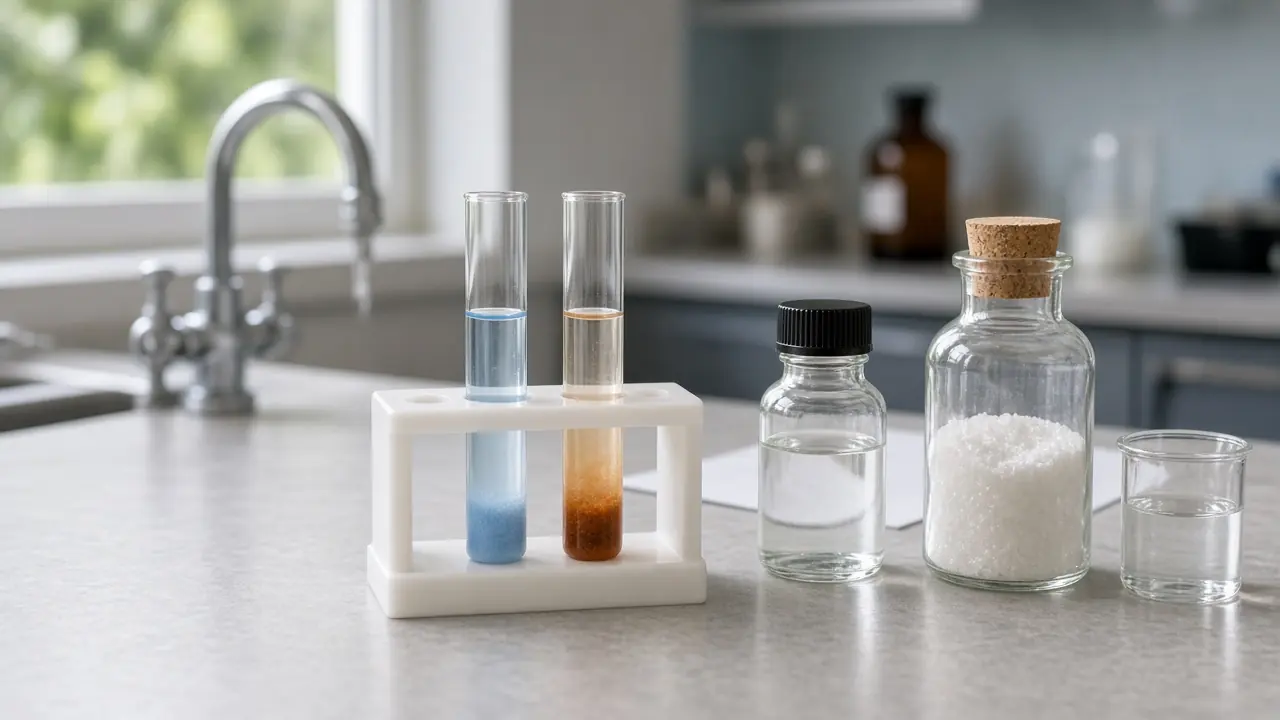
Procedure
- Note the colour and physical state of the salt. Perform any dry heating test your manual requires.
- Treat a small portion with dilute acid as directed. Note gas evolution and odour only as your teacher allows.Safety: Never smell gases deeply. Waft if your teacher demonstrates that method. Concentrated acids burn skin and lungs.
- Prepare the sodium carbonate extract or use the wet tests your manual specifies for anion groups.
- Perform confirmatory tests for the suspected anion. Record reagents, observations, and inference.
- State the anion identified. Cross-check with any cation work your syllabus pairs with this salt.
Observation table
Enter the readings from your school lab in the practical file below. This page does not fill them in for you.
Calculation
No calculation. Qualitative identification only.
Result
The anion present in the given salt is ________ (write the ion you confirmed).
Precautions
- Use only school reagents and the unknown salt issued to you.
- Work with concentrated acids under teacher supervision.
- Do not perform salt analysis at home.
- Label tubes; do not mix droppers across reagents.
Viva questions
Answer one question at a time. The full answers stay closed until you open them.
Question 1 of 4
Carbonate with dilute acid typically liberates…
Pick an answer first.
Show all questions and answers
Carbonate with dilute acid typically liberates…
Answer: Carbon dioxide. Reason: CO₃²⁻ + acid → CO₂ gas.
Chloride is often confirmed with AgNO₃ as…
Answer: A white ppt soluble in NH₄OH (as taught). Reason: AgCl is a classic white precipitate; solubility in ammonia is part of many school schemes.
Why do salt-analysis pages insist on school supervision?
Answer: Because concentrated acids and toxic gases are involved. Reason: Many confirmatory reagents and acids are hazardous outside a supervised lab.
Sulphate with BaCl₂ in acid medium typically gives…
Answer: A white ppt of BaSO₄. Reason: BaSO₄ is a characteristic white precipitate for sulphate.
Common mistakes
- Skipping confirmatory tests after one preliminary bubble.
- Using the wrong acid strength for a group test.
- Writing an anion that contradicts the confirmatory observation.
Frequently asked questions
- Can I do this at home?
- No. Use this page to practise the order of steps and viva. Do the real experiment only in your school laboratory, with your teacher present.
- Will this page tell me every anion test for every board?
- No. Boards and manuals differ. Follow the exact sequence and reagents your teacher and laboratory manual use.
Your practical file
Name, school, and roll number are optional and are not sent anywhere.
The practical file opens on this device.
Review
Not yet reviewed by a named chemistry reviewer. Published for practice only — follow your teacher and laboratory manual for quantities and safety.
Related practicals
- Titration of KMnO4 with oxalic acid
- Titration of KMnO4 with Mohr’s salt
- Preparation of Mohr’s salt
- Preparation of potash alum
- Lyophilic and lyophobic sols
- Dialysis of a sol
- Emulsions and emulsifying agents
- Rate of reaction between sodium thiosulphate and hydrochloric acid
- Clock reaction (iodine clock)
- Enthalpy of dissolution
- Enthalpy of neutralisation (Class 12)
- Concentration cell: cell potential and Nernst equation
- Paper chromatography of leaf and flower pigments
- Preparation of potassium trioxalatoferrate(III)
- Preparation of acetanilide
- Detection of functional groups (Class 12)
- Tests for carbohydrates, fats, and proteins in foodstuffs
- Salt analysis: cations (Class 12)