
CBSE Class 12 chemistry practical · Volumetric analysis
Source: CBSE Class 12 chemistry practical syllabus · use your school laboratory manual (NCERT Lab Manual where your school uses it).
Titration of KMnO4 with Mohr’s salt (Class 12 chemistry practical)
You standardise or find the strength of KMnO₄ using Mohr’s salt as the reducing agent.
Record your own concordant readings. Strengths and worked numbers come from your manual and your titres.
Published practice page. Concentrations, masses, and numerical answers come from your school laboratory manual and your own readings — not invented here. Not yet reviewed by a named chemistry reviewer. Version 1.0.0, updated 2026-10-03.
Safety — read before you start
Safety warning. Practise here. Perform the real experiment only in your school lab, with your teacher present.
- Dilute sulphuric acid is corrosive.
- Iron(II) solutions can irritate; follow your teacher’s handling rules.
- KMnO₄ is an oxidiser and stains.
Wear: Lab coat, Splash goggles, Gloves, as your teacher directs.
Follow your teacher’s disposal instructions. Do not pour leftovers down a household drain.
Loads only after you tap. Use the lab hands to pick up and use equipment (pointer hidden in the scene). Falls back to a flat diagram if WebGL is unavailable.
Aim
To determine the strength (molarity) of a potassium permanganate solution by titrating it against a standard Mohr’s salt solution, using the values in your laboratory manual.
Methods and quantities can differ between schools. Follow your teacher's instructions.
Apparatus and chemicals
| Item | Note |
|---|---|
| Burette and stand | For KMnO₄ solution. |
| Pipette and filler | For Mohr’s salt solution. Do not pipette by mouth. |
| Conical flask | Rinse with distilled water only. |
| White tile | Helps you see the pale pink end point. |
| Wash bottle | Distilled water. |
| Potassium permanganate solution (KMnO4) | In the burette. Use the concentration, mass, and volume values printed in your school laboratory manual. This page does not invent a numerical result for you. |
| Mohr’s salt solution ((NH4)2Fe(SO4)2·6H2O) | Standard ferrous ammonium sulphate solution from your manual. Use the concentration, mass, and volume values printed in your school laboratory manual. This page does not invent a numerical result for you. |
| Dilute sulphuric acid (H2SO4) | Keeps the medium acidic. Volume as in your manual. Do not use HCl or HNO₃. |
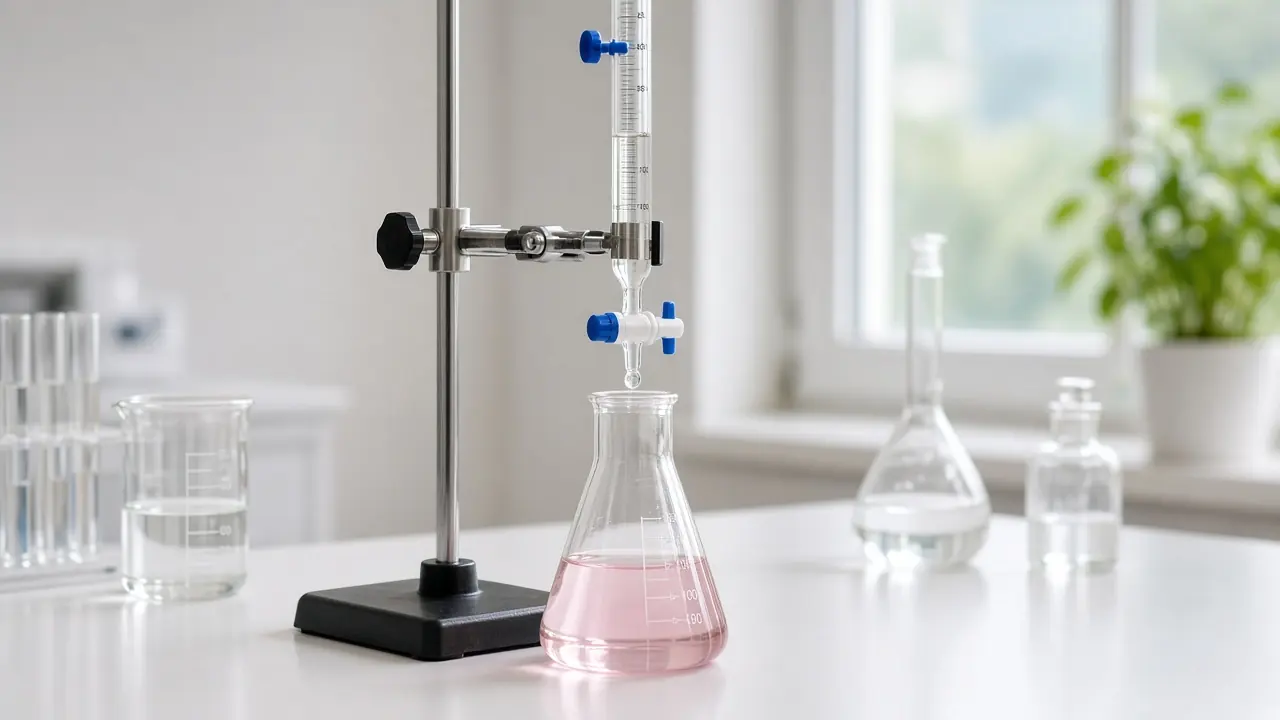
Theory and reaction
Open
In acid medium, MnO4- oxidises Fe2+ to Fe3+. Permanganate is reduced to almost colourless Mn2+.
Mohr’s salt provides Fe2+ and is more stable than simple ferrous sulphate for school work when prepared as directed.
No external indicator is needed. The end point is the first lasting pale pink from a slight excess of KMnO4.
Mole ratio from the balanced equation: 1 mol MnO4- reacts with 5 mol Fe2+.
MnO4- + 5 Fe2+ + 8 H+ gives Mn2+ + 5 Fe3+ + 4 H2O
Procedure
- Rinse and fill the burette with KMnO₄. Remove air bubbles. Note the initial reading.
- Pipette the Mohr’s salt volume your manual states into a clean conical flask.
- Add dilute sulphuric acid as your manual directs.Safety: Dilute sulphuric acid is corrosive.
- Titrate with KMnO₄ while swirling until the first pale pink that persists.
- Record final reading. Repeat for concordant titres.
Observation table
Enter the readings from your school lab in the practical file below. This page does not fill them in for you.
Calculation
Use MnO₄⁻ : Fe²⁺ = 1 : 5, the Mohr’s salt concentration and pipette volume from your manual, and your concordant titre. Write the molarity of KMnO₄ with units.
Result
State the molarity (or strength) of KMnO₄ you obtain from your own concordant readings.
Precautions
- Keep the medium acidic with dilute H₂SO₄ as directed — not HCl or HNO₃.
- Rinse the burette with KMnO₄ and the pipette with Mohr’s salt.
- Do not rinse the conical flask with Mohr’s salt after pipetting.
- Stop at lasting pale pink, not deep purple.
Viva questions
Answer one question at a time. The full answers stay closed until you open them.
Question 1 of 4
What is Mohr’s salt chemically?
Pick an answer first.
Show all questions and answers
What is Mohr’s salt chemically?
Answer: Ferrous ammonium sulphate hexahydrate. Reason: Mohr’s salt is (NH₄)₂Fe(SO₄)₂·6H₂O.
MnO₄⁻ : Fe²⁺ mole ratio in acid medium is…
Answer: 1 : 5. Reason: One permanganate oxidises five Fe²⁺ ions.
Why is no external indicator used?
Answer: KMnO₄ is self-indicating (pale pink at end point). Reason: Excess KMnO₄ gives a lasting pale pink.
Which acid medium is preferred?
Answer: Dilute H₂SO₄. Reason: Dilute sulphuric acid is the usual medium for this school titration.
Common mistakes
- Using HCl (can be oxidised by KMnO₄) or HNO₃ (oxidising acid).
- Adding a separate indicator.
- Confusing the 1:5 Fe²⁺ ratio with the 2:5 oxalate ratio.
Frequently asked questions
- Can I do this at home?
- No. Use this page to practise the order of steps and viva. Do the real experiment only in your school laboratory, with your teacher present.
- Is this the same calculation as the oxalic acid titration?
- No. The balanced mole ratio is different (1:5 with Fe²⁺ vs 2:5 with oxalate). Always use the equation for the reducing agent you used.
Your practical file
Name, school, and roll number are optional and are not sent anywhere.
The practical file opens on this device.
Review
Not yet reviewed by a named chemistry reviewer. Published for practice only — follow your teacher and laboratory manual for quantities and safety.
Related notes
Related practicals
- Titration of KMnO4 with oxalic acid
- Preparation of Mohr’s salt
- Preparation of potash alum
- Salt analysis: anions
- Lyophilic and lyophobic sols
- Dialysis of a sol
- Emulsions and emulsifying agents
- Rate of reaction between sodium thiosulphate and hydrochloric acid
- Clock reaction (iodine clock)
- Enthalpy of dissolution
- Enthalpy of neutralisation (Class 12)
- Concentration cell: cell potential and Nernst equation
- Paper chromatography of leaf and flower pigments
- Preparation of potassium trioxalatoferrate(III)
- Preparation of acetanilide
- Detection of functional groups (Class 12)
- Tests for carbohydrates, fats, and proteins in foodstuffs
- Salt analysis: cations (Class 12)