
CBSE Class 12 chemistry practical · Preparation of compounds
Source: CBSE Class 12 chemistry practical syllabus · use your school laboratory manual (NCERT Lab Manual where your school uses it).
Preparation of potash alum (Class 12 chemistry practical)
You mix potassium sulphate and aluminium sulphate solutions, then crystallise potash alum.
Weighed amounts and percentage yield come from your workbench — not from a fixed number on this page.
Published practice page. Concentrations, masses, and numerical answers come from your school laboratory manual and your own readings — not invented here. Not yet reviewed by a named chemistry reviewer. Version 1.0.0, updated 2026-10-03.
Safety — read before you start
Safety warning. Practise here. Perform the real experiment only in your school lab, with your teacher present.
- Hot solutions can scald.
- Dilute acid (if used) is corrosive.
- Broken glassware cuts.
Wear: Lab coat, Splash goggles, Gloves, as your teacher directs.
Follow your teacher’s disposal instructions. Do not pour leftovers down a household drain.
Loads only after you tap. Use the lab hands to pick up and use equipment (pointer hidden in the scene). Falls back to a flat diagram if WebGL is unavailable.
Aim
To prepare crystals of potash alum (KAl(SO₄)₂·12H₂O) using the reagents and quantities in your laboratory manual.
Methods and quantities can differ between schools. Follow your teacher's instructions.
Apparatus and chemicals
| Item | Note |
|---|---|
| Beakers | Dissolving each salt. |
| Glass rod | Stirring. |
| Funnel and filter paper | If hot filtration is required. |
| China dish / crystallising dish | For slow cooling. |
| Balance | Reagents and yield. |
| Potassium sulphate (K2SO4) | Use the concentration, mass, and volume values printed in your school laboratory manual. This page does not invent a numerical result for you. |
| Aluminium sulphate (Al2(SO4)3 hydrate) | Use the hydrate form and mass your manual specifies. |
| Dilute sulphuric acid (if required) (H2SO4) | Only if your manual adds a few drops during dissolution. |
| Distilled water (H2O) | Solvent. |
Theory and reaction
Open
Potash alum is a double salt: K2SO4·Al2(SO4)3·24H2O, often written KAl(SO4)2·12H2O.
Equimolar amounts (as per manual) of the two sulphates dissolve and crystallise together on cooling.
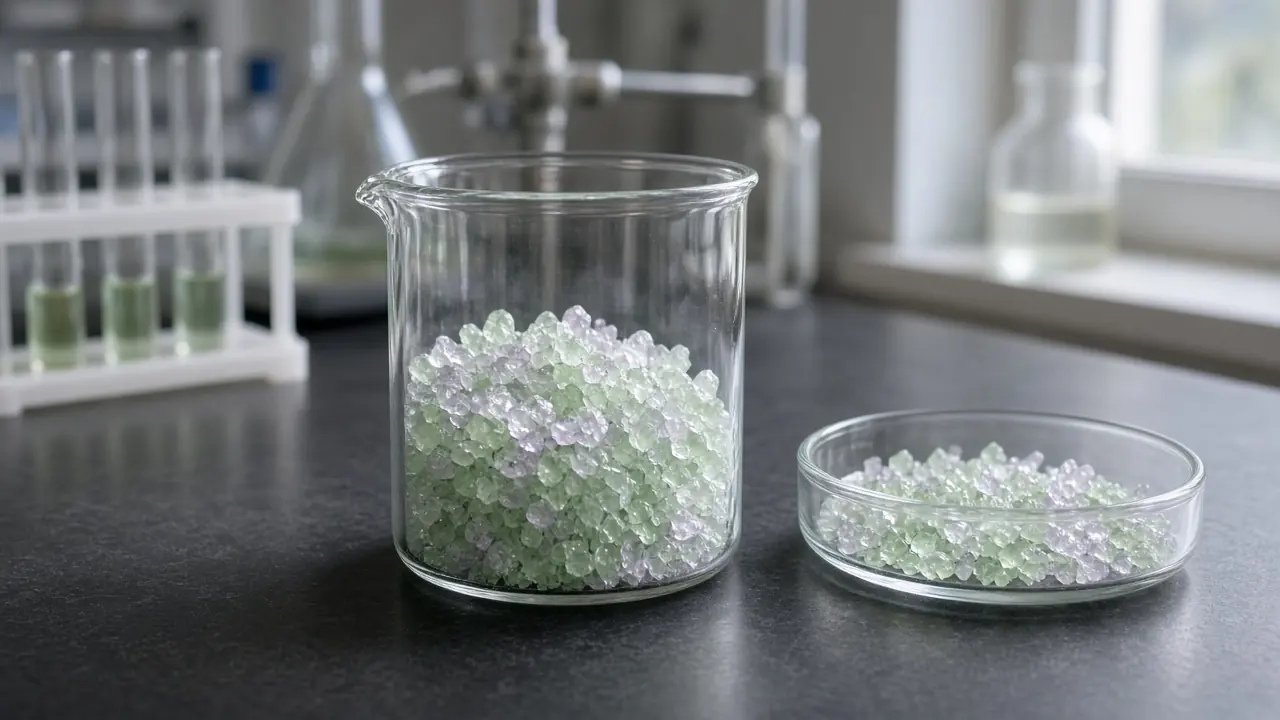
Alums form octahedral crystals when grown slowly.
Potassium sulphate plus aluminium sulphate plus water gives potash alum dodecahydrate.
Picture guide
Procedure
- Weigh K₂SO₄ and aluminium sulphate as your manual states.
- Dissolve each salt separately in the minimum hot distilled water (and acid if the manual adds it).
- Mix the hot solutions, filter if instructed, and set aside for slow crystallisation.
- Separate crystals, wash briefly if directed, dry, and weigh.
Observation table
Enter the readings from your school lab in the practical file below. This page does not fill them in for you.
Calculation
Find theoretical yield from the limiting reagent and molar masses your teacher expects. Percentage yield = (actual / theoretical) × 100.
Result
Report mass of potash alum obtained and percentage yield if asked.
Precautions
- Use clean glassware — coloured impurities spoil crystal appearance.
- Cool slowly for better crystals.
- Do not over-wash crystals or they redissolve.
Viva questions
Answer one question at a time. The full answers stay closed until you open them.
Question 1 of 3
The common school formula for potash alum is often written as…
Pick an answer first.
Show all questions and answers
The common school formula for potash alum is often written as…
Answer: KAl(SO₄)₂·12H₂O. Reason: Potash alum is potassium aluminium sulphate dodecahydrate.
Potash alum is an example of…
Answer: A double salt. Reason: Two simple salts crystallise together in a fixed ratio.
Why cool slowly during crystallisation?
Answer: To grow larger, better-shaped crystals. Reason: Slow cooling favours orderly crystal growth.
Common mistakes
- Boiling the mixed solution dry instead of crystallising.
- Using dirty vessels that seed unwanted colours.
- Copying a friend’s yield.
Frequently asked questions
- Can I do this at home?
- No. Use this page to practise the order of steps and viva. Do the real experiment only in your school laboratory, with your teacher present.
Your practical file
Name, school, and roll number are optional and are not sent anywhere.
The practical file opens on this device.
Review
Not yet reviewed by a named chemistry reviewer. Published for practice only — follow your teacher and laboratory manual for quantities and safety.
Related practicals
- Titration of KMnO4 with oxalic acid
- Titration of KMnO4 with Mohr’s salt
- Preparation of Mohr’s salt
- Salt analysis: anions
- Lyophilic and lyophobic sols
- Dialysis of a sol
- Emulsions and emulsifying agents
- Rate of reaction between sodium thiosulphate and hydrochloric acid
- Clock reaction (iodine clock)
- Enthalpy of dissolution
- Enthalpy of neutralisation (Class 12)
- Concentration cell: cell potential and Nernst equation
- Paper chromatography of leaf and flower pigments
- Preparation of potassium trioxalatoferrate(III)
- Preparation of acetanilide
- Detection of functional groups (Class 12)
- Tests for carbohydrates, fats, and proteins in foodstuffs
- Salt analysis: cations (Class 12)