
CBSE Class 12 chemistry practical, Chemical kinetics · Physical chemistry experiments
Source: CBSE Class 12 chemistry practical syllabus · use your school laboratory manual (NCERT Lab Manual where your school uses it).
Clock reaction (iodine clock) (Class 12 chemistry practical)
Your school may use the iodate–sulphite–starch clock or the iodide–hydrogen peroxide clock.
Follow the recipe in your manual; record induction times from your stopwatch only.
Published practice page. Concentrations, masses, and numerical answers come from your school laboratory manual and your own readings — not invented here. Not yet reviewed by a named chemistry reviewer. Version 1.0.0, updated 2026-10-03.
Safety — read before you start
Safety warning. Practise here. Perform the real experiment only in your school lab, with your teacher present.
- Iodate, peroxide, and acid solutions are oxidising or corrosive — avoid skin and eye contact.
- Do not inhale vapours from acidified mixtures. Work in a ventilated school lab only.
Wear: Lab coat, Splash goggles, Gloves, as your teacher directs.
Follow your teacher’s disposal instructions. Do not pour leftovers down a household drain.
Loads only after you tap. Use the lab hands to pick up and use equipment (pointer hidden in the scene). Falls back to a flat diagram if WebGL is unavailable.
Aim
To study a clock reaction by measuring the time until a sudden colour change appears, and to see how changing concentration or temperature affects that time, as directed in your laboratory manual.
Methods and quantities can differ between schools. Follow your teacher's instructions.
Apparatus and chemicals
| Item | Note |
|---|---|
| Test tubes or small flasks | Clean; starch sticks to dirty glass. |
| Measuring cylinders / pipettes | Separate for each solution if manual requires. |
| Stopwatch | Start when solutions are mixed. |
| Water bath (optional) | For temperature variation. |
| Potassium iodate solution (KIO3) | If manual uses iodate–sulphite clock. |
| Sodium sulphite solution (Na2SO3) | Use the concentration, mass, and volume values printed in your school laboratory manual. This page does not invent a numerical result for you. |
| Starch solution (starch) | Indicator for iodine. |
| Alternative: KI and H₂O₂ (if manual) (KI H2O2) | Use only the variant your school assigns. |
| Dilute sulphuric acid (if required) (H2SO4) | For acidified iodate clock only. |
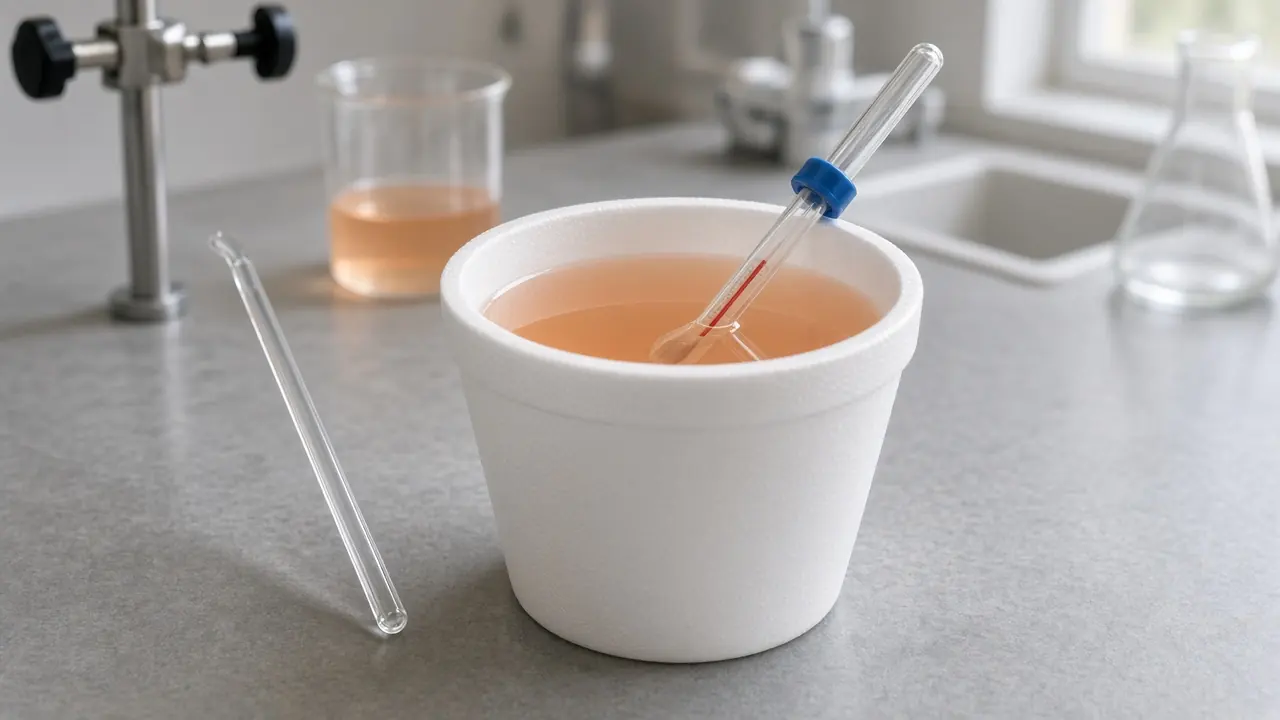
Theory and reaction
Open
A clock reaction shows a lag period then a sharp colour change when a trace of iodine forms and binds to starch.
In the iodate–sulphite system, sulphite first consumes iodine produced; when sulphite is exhausted, iodine appears and starch turns blue-black.
Rate studies use induction time versus concentration or temperature — compare trends from your table.
Iodate is reduced by sulphite until sulphite runs out; then iodine forms and starch gives a blue colour.
Procedure
- Prepare separate solutions at the concentrations your manual lists (iodate, sulphite, starch, acid if used).
- Mix them in the order and proportions the manual specifies in one flask.
- Start the stopwatch at the moment of final mixing. Swirl gently.
- Record the time to the sudden blue-black colour. Repeat for other concentrations or temperatures assigned.
- Tabulate induction time versus the variable changed. Do not copy a standard time from a video.Safety: Some clock mixtures use acid — corrosive. Peroxide oxidises — avoid skin contact.
Observation table
Enter the readings from your school lab in the practical file below. This page does not fill them in for you.
Calculation
Discuss how induction time changed with concentration or temperature using your data. Optional: plot log time versus log concentration if teacher asks.
Result
State the trend (e.g. shorter induction time at higher iodate concentration) based on your measurements.
Precautions
- Mix in the manual’s order — order can matter for clock reactions.
- Fresh starch solution gives clearer colour.
- Same room temperature unless temperature is the variable.
Viva questions
Answer one question at a time. The full answers stay closed until you open them.
Question 1 of 4
The sudden colour in the iodine clock appears when…
Pick an answer first.
Show all questions and answers
The sudden colour in the iodine clock appears when…
Answer: Free iodine becomes available to form the starch complex. Reason: After sulphite is used up, I₂ forms and starch turns blue-black.
Clock reactions are useful for studying kinetics because…
Answer: Induction time links to underlying rate laws in a measurable way. Reason: The lag before the colour jump reflects competing steps in the mechanism.
Starch in this experiment acts as…
Answer: An indicator for iodine. Reason: Starch forms a deep blue complex with iodine.
Raising temperature usually…
Answer: Increases rate (shorter induction time) for many clock runs. Reason: Higher T increases rate constants per Arrhenius behaviour.
Common mistakes
- Using stale starch.
- Stopping the watch at first pale yellow instead of the sharp starch–iodine blue.
- Combining reagents from the wrong variant (iodate clock vs peroxide clock).
Frequently asked questions
- Can I do this at home?
- No. Use this page to practise the order of steps and viva. Do the real experiment only in your school laboratory, with your teacher present.
Your practical file
Name, school, and roll number are optional and are not sent anywhere.
The practical file opens on this device.
Review
Not yet reviewed by a named chemistry reviewer. Published for practice only — follow your teacher and laboratory manual for quantities and safety.
Related practicals
- Titration of KMnO4 with oxalic acid
- Titration of KMnO4 with Mohr’s salt
- Preparation of Mohr’s salt
- Preparation of potash alum
- Salt analysis: anions
- Lyophilic and lyophobic sols
- Dialysis of a sol
- Emulsions and emulsifying agents
- Rate of reaction between sodium thiosulphate and hydrochloric acid
- Enthalpy of dissolution
- Enthalpy of neutralisation (Class 12)
- Concentration cell: cell potential and Nernst equation
- Paper chromatography of leaf and flower pigments
- Preparation of potassium trioxalatoferrate(III)
- Preparation of acetanilide
- Detection of functional groups (Class 12)
- Tests for carbohydrates, fats, and proteins in foodstuffs
- Salt analysis: cations (Class 12)