
CBSE Class 12 chemistry practical, Thermochemistry · Physical chemistry experiments
Source: CBSE Class 12 chemistry practical syllabus · use your school laboratory manual (NCERT Lab Manual where your school uses it).
Enthalpy of neutralisation (Class 12) (Class 12 chemistry practical)
You mix equal or manual-specified volumes of acid and base and measure the temperature rise.
This is the Class 12 thermochemistry practical — use the concentrations and calorimeter constant from your manual.
Published practice page. Concentrations, masses, and numerical answers come from your school laboratory manual and your own readings — not invented here. Not yet reviewed by a named chemistry reviewer. Version 1.0.0, updated 2026-10-03.
Safety — read before you start
Safety warning. Practise here. Perform the real experiment only in your school lab, with your teacher present.
- HCl and NaOH are corrosive to skin and eyes.
- Wipe spills immediately; never pipette by mouth.
Wear: Lab coat, Splash goggles, Gloves, as your teacher directs.
Follow your teacher’s disposal instructions. Do not pour leftovers down a household drain.
Loads only after you tap. Use the lab hands to pick up and use equipment (pointer hidden in the scene). Falls back to a flat diagram if WebGL is unavailable.
Aim
To determine the enthalpy of neutralisation of a strong acid with a strong base using a calorimeter, reporting ΔH from your own temperature measurements.
Methods and quantities can differ between schools. Follow your teacher's instructions.
Apparatus and chemicals
| Item | Note |
|---|---|
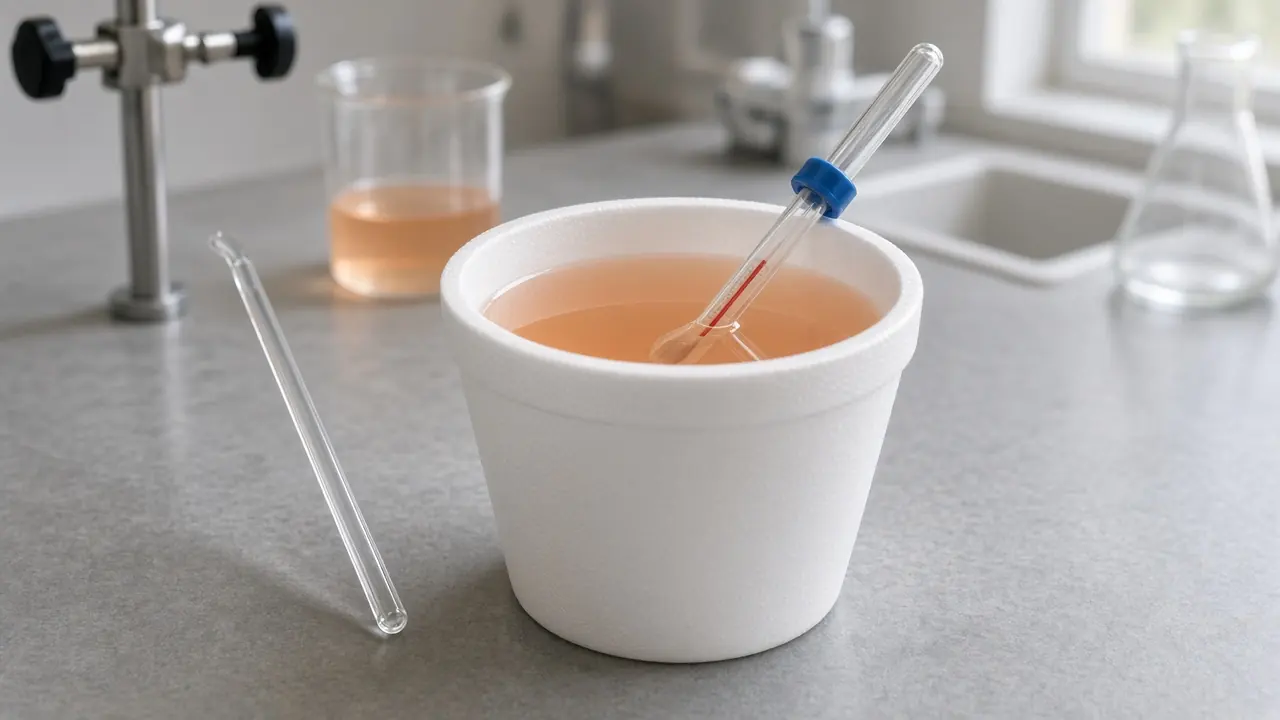
| Calorimeter (polystyrene cups) | Nested cups if your school uses them. |
| Thermometer | Read to manual precision. |
| Pipette or measuring cylinder | Equal volumes if manual says 50 mL + 50 mL. |
| Glass rod | Stir after mixing. |
| Hydrochloric acid solution (HCl) | Use the concentration, mass, and volume values printed in your school laboratory manual. This page does not invent a numerical result for you. |
| Sodium hydroxide solution (NaOH) | Match normality/molarity to manual. |
Theory and reaction
Open
Neutralisation of strong acid and strong base: H+(aq) + OH-(aq) → H2O(l).
At constant pressure, heat evolved ≈ ΔH × moles of water formed (for the strong–strong case, extra ionisation terms are small).
Heat loss to the bench lowers ΔT — quick mixing and a lid help.
Hydrogen ion and hydroxide form water.
Procedure
- Measure acid volume into the calorimeter. Record temperature T₁.
- Measure base volume separately. Record its temperature if manual requires average initial T.Safety: NaOH and HCl are corrosive.
- Pour base into acid (or as manual orders). Stir, lid on, record maximum stable T₂.
- Repeat for concordant readings if teacher asks. Average ΔT.
- Calculate ΔH per mole of water formed using manual’s heat capacity and total mass of solution.
Observation table
Enter the readings from your school lab in the practical file below. This page does not fill them in for you.
Calculation
q = (m_total × c + C_cal) × ΔT. Moles H₂O ≈ moles limiting H⁺ or OH⁻. ΔH = −q/n (exothermic, sign as teacher teaches). No invented −57 kJ on this sheet.
Result
Write enthalpy of neutralisation in kJ mol⁻¹ from your concordant runs.
Precautions
- Same technique for every trial.
- Thermometer bulb fully immersed, not touching cup bottom.
- Use solutions at similar starting temperatures.
Viva questions
Answer one question at a time. The full answers stay closed until you open them.
Question 1 of 4
Strong acid + strong base neutralisation is mainly…
Pick an answer first.
Show all questions and answers
Strong acid + strong base neutralisation is mainly…
Answer: Formation of H₂O from H⁺ and OH⁻. Reason: The net ionic equation is H⁺ + OH⁻ → H₂O.
Why might weak acid neutralisation ΔH differ from strong–strong?
Answer: Energy is used to ionise the weak acid. Reason: Partial ionisation adds an enthalpy term beyond H⁺ + OH⁻.
ΔH at constant pressure equals…
Answer: q_p for the process (with sign convention as taught). Reason: At constant P, ΔH equals heat measured for many school setups.
Heat capacity of the calorimeter accounts for…
Answer: Heat absorbed by the cup assembly. Reason: The cup also warms, so C_cal may be added in the manual’s formula.
Common mistakes
- Using only acid mass in m instead of total solution mass.
- Forgetting negative sign for exothermic neutralisation.
- Pasting literature ΔH without calorimeter calculation.
Frequently asked questions
- Can I do this at home?
- No. Use this page to practise the order of steps and viva. Do the real experiment only in your school laboratory, with your teacher present.
Your practical file
Name, school, and roll number are optional and are not sent anywhere.
The practical file opens on this device.
Review
Not yet reviewed by a named chemistry reviewer. Published for practice only — follow your teacher and laboratory manual for quantities and safety.
Related note
Open the theory noteRelated practicals
- Titration of KMnO4 with oxalic acid
- Titration of KMnO4 with Mohr’s salt
- Preparation of Mohr’s salt
- Preparation of potash alum
- Salt analysis: anions
- Lyophilic and lyophobic sols
- Dialysis of a sol
- Emulsions and emulsifying agents
- Rate of reaction between sodium thiosulphate and hydrochloric acid
- Clock reaction (iodine clock)
- Enthalpy of dissolution
- Concentration cell: cell potential and Nernst equation
- Paper chromatography of leaf and flower pigments
- Preparation of potassium trioxalatoferrate(III)
- Preparation of acetanilide
- Detection of functional groups (Class 12)
- Tests for carbohydrates, fats, and proteins in foodstuffs
- Salt analysis: cations (Class 12)