
Class 11 chemistry · linked to Thermodynamics basics · Physical chemistry experiments
Source: CBSE Class 11 chemistry practical syllabus · use your school laboratory manual (NCERT Lab Manual where your school uses it).
Enthalpy of neutralisation (Class 11 chemistry practical)
You mix acid and base in an insulated cup and track temperature change.
Volumes, molarities, and the calorimeter constant (if used) come from your manual.
Published practice page. Concentrations, masses, and numerical answers come from your school laboratory manual and your own readings — not invented here. Not yet reviewed by a named chemistry reviewer. Version 1.0.0, updated 2026-10-03.
Safety — read before you start
Safety warning. Practise here. Perform the real experiment only in your school lab, with your teacher present.
- Dilute acids and bases still burn skin and eyes.
- Broken thermometers may contain hazardous fillings — handle as taught.
Wear: Lab coat, Splash goggles, Gloves, as your teacher directs.
Follow your teacher’s disposal instructions. Do not pour leftovers down a household drain.
Loads only after you tap. Use the lab hands to pick up and use equipment (pointer hidden in the scene). Falls back to a flat diagram if WebGL is unavailable.
Aim
To determine the enthalpy of neutralisation for the acid–base pair in your laboratory manual using a simple calorimeter, without copying a pre-filled ΔH from elsewhere.
Methods and quantities can differ between schools. Follow your teacher's instructions.
Apparatus and chemicals
| Item | Note |
|---|---|
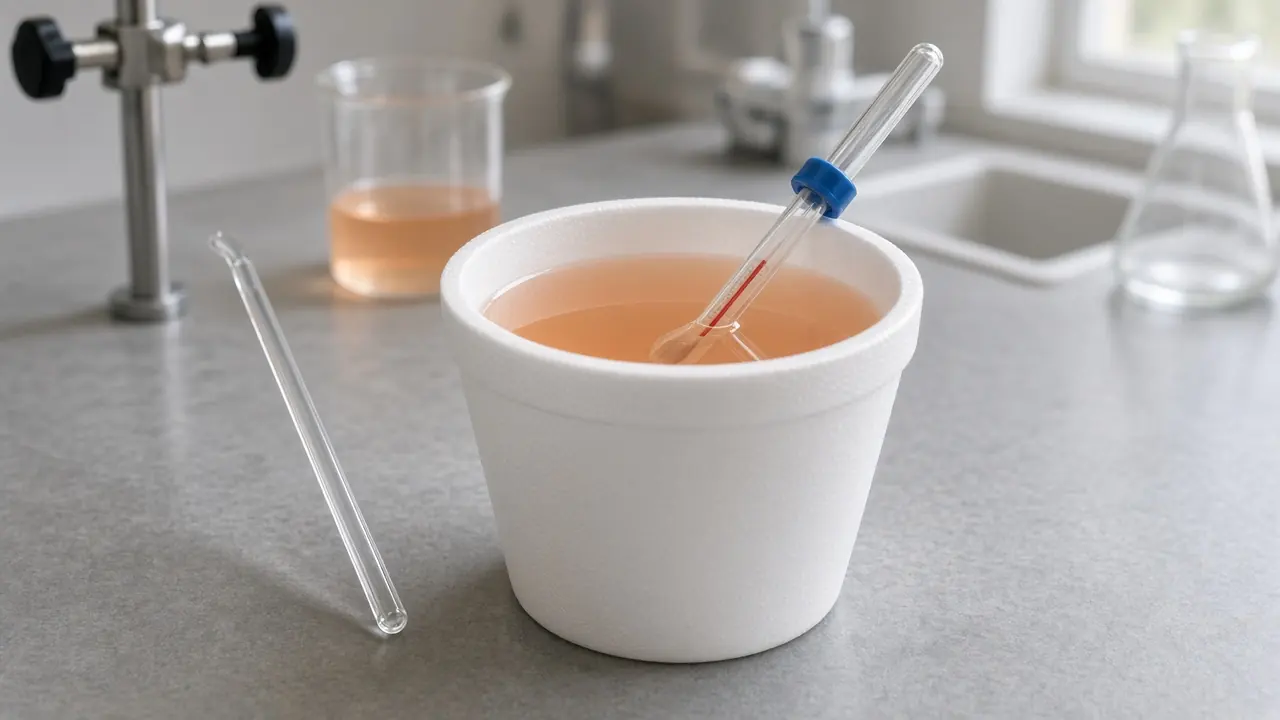
| Polystyrene / school calorimeter | Lid with hole for the thermometer. |
| Thermometer | Resolution as per manual. |
| Measuring cylinder or pipette | For the volumes your manual states. |
| Glass rod | Gentle stir — do not break the thermometer bulb. |
| Strong acid solution (acid) | Use the concentration in your laboratory manual. |
| Strong base solution (base) | Use the concentration in your laboratory manual. |
Theory and reaction
Open
At constant pressure, heat released ≈ q_p related to ΔH.
q = m c ΔT for the solution (and calorimeter term if your manual includes it).
For strong acid + strong base, the essential reaction is H+ + OH- → H2O. Weak acids/bases need extra dissociation heat — your manual will say which pair you have.
H+ plus OH- gives water.
Procedure
- Measure the acid volume your manual states into the calorimeter. Record initial temperature.
- Measure the base the same way. Record its temperature if the manual asks for a separate reading.Safety: Acids and bases are corrosive. Wipe spills as your teacher shows.
- Mix quickly, lid on, stir gently. Record the highest (or stable) temperature your manual asks for.
- Compute ΔT and q using only the formula and constants in your manual.
- Report ΔH per mole of water formed (or as the manual defines the basis).
Observation table
Enter the readings from your school lab in the practical file below. This page does not fill them in for you.
Calculation
Use q = m c ΔT (and calorimeter correction if given). Divide by moles of limiting reagent / water as your manual defines. No sample arithmetic with invented numbers here.
Result
Write ΔH with sign and unit (kJ mol⁻¹) from your own temperatures.
Precautions
- Read the thermometer at eye level.
- Mix promptly so heat is not lost before you record T.
- Do not use a glass beaker as if it were a perfect insulator unless that is the school method.
Viva questions
Answer one question at a time. The full answers stay closed until you open them.
Question 1 of 3
ΔH for an exothermic neutralisation is usually…
Pick an answer first.
Show all questions and answers
ΔH for an exothermic neutralisation is usually…
Answer: Negative. Reason: Heat leaves the system; ΔH is negative by convention.
q at constant pressure corresponds to…
Answer: ΔH. Reason: q_p = ΔH.
Hess’s law says overall ΔH…
Answer: Is path-independent for the same start/end. Reason: State function behaviour for enthalpy.
Common mistakes
- Forgetting the sign (exothermic ⇒ negative ΔH in the usual chemistry convention).
- Using mass of only one solution when the manual says to add both masses.
- Copying −57.1 kJ mol⁻¹ into the file without measuring.
Frequently asked questions
- Can I do this at home?
- No. Use this page to practise the order of ideas and steps. Do the real experiment only in your school laboratory, with your teacher present.
Your practical file
Name, school, and roll number are optional and are not sent anywhere.
The practical file opens on this device.
Review
Not yet reviewed by a named chemistry reviewer. Published for practice only — follow your teacher and laboratory manual for quantities and safety.
Related notes
Related practicals
- Electron shells and quantum numbers
- Preparing a molar solution
- Periodic trends comparison
- Displacement redox reaction
- Detection of functional groups
- Tests for unsaturation
- Bending a glass tube
- Cutting a glass tube
- Drawing a glass jet
- Boring a cork
- Determination of melting point
- Determination of boiling point
- Purification by crystallisation
- Determination of pH of solutions
- Effect of common ion on pH
- Shift in chemical equilibrium
- Standard oxalic acid solution
- Titration of NaOH with oxalic acid
- Standard sodium carbonate solution
- Titration of HCl with sodium carbonate
- Qualitative salt analysis (one cation, one anion)
- Detection of N, S and halogen (Lassaigne)